
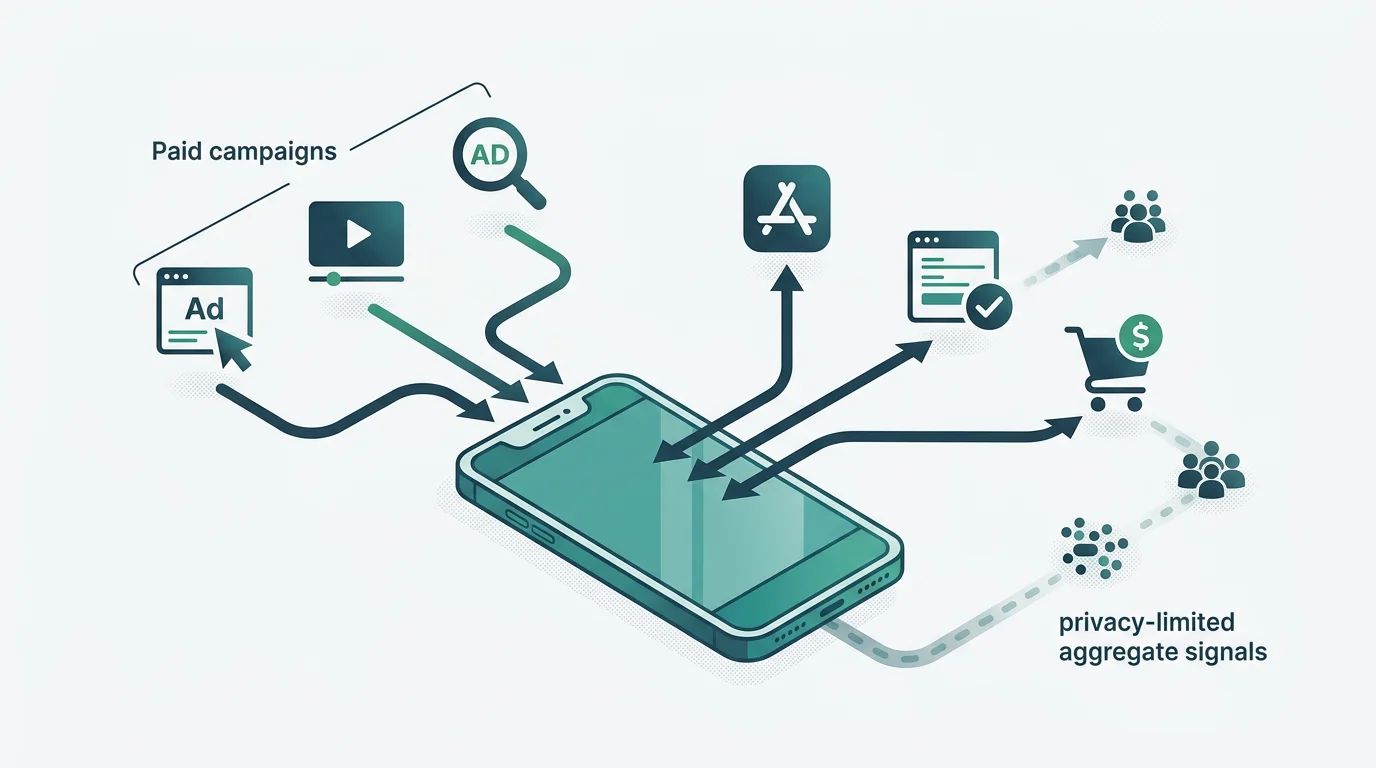
By Andrei Kholkin · Reviews / Mobile Marketing
Meta reports one install total. Your MMP reports another. App Store downloads and backend registrations tell different stories again. The buying question is not which dashboard promises one perfect number. It is which mobile measurement partner gives your team an attribution framework you can explain, maintain, and use to make responsible budget decisions.
This Adjust review focuses on that decision. Adjust fits the mobile acquisition layer: app install attribution, reattribution, in-app event measurement, deep linking, fraud filtering, and privacy-oriented iOS reporting. Its usefulness depends on your implementation, acquisition partners, event definitions, and reporting requirements—not just the dashboard.

What is Adjust—and where does it fit?
Adjust is a mobile measurement platform. Its scope includes app install attribution, reattribution, in-app and server-to-server events, campaign measurement, deep linking, fraud filtering, and iOS measurement involving SKAdNetwork and AdAttributionKit.
For a subscription app, install credit is only the start. The practical goal is to connect acquisition with meaningful outcomes: completed onboarding, registration, trial activation, purchase, and subsequent value. Those outcomes need consistent definitions before campaign comparisons become useful.
Adjust is most relevant when mobile acquisition is the central measurement problem. A web-only store measuring checkout orders, or a product team investigating feature adoption without paid acquisition, has a different primary requirement.
Five measurement jobs that should stay separate
User-level attributed reporting
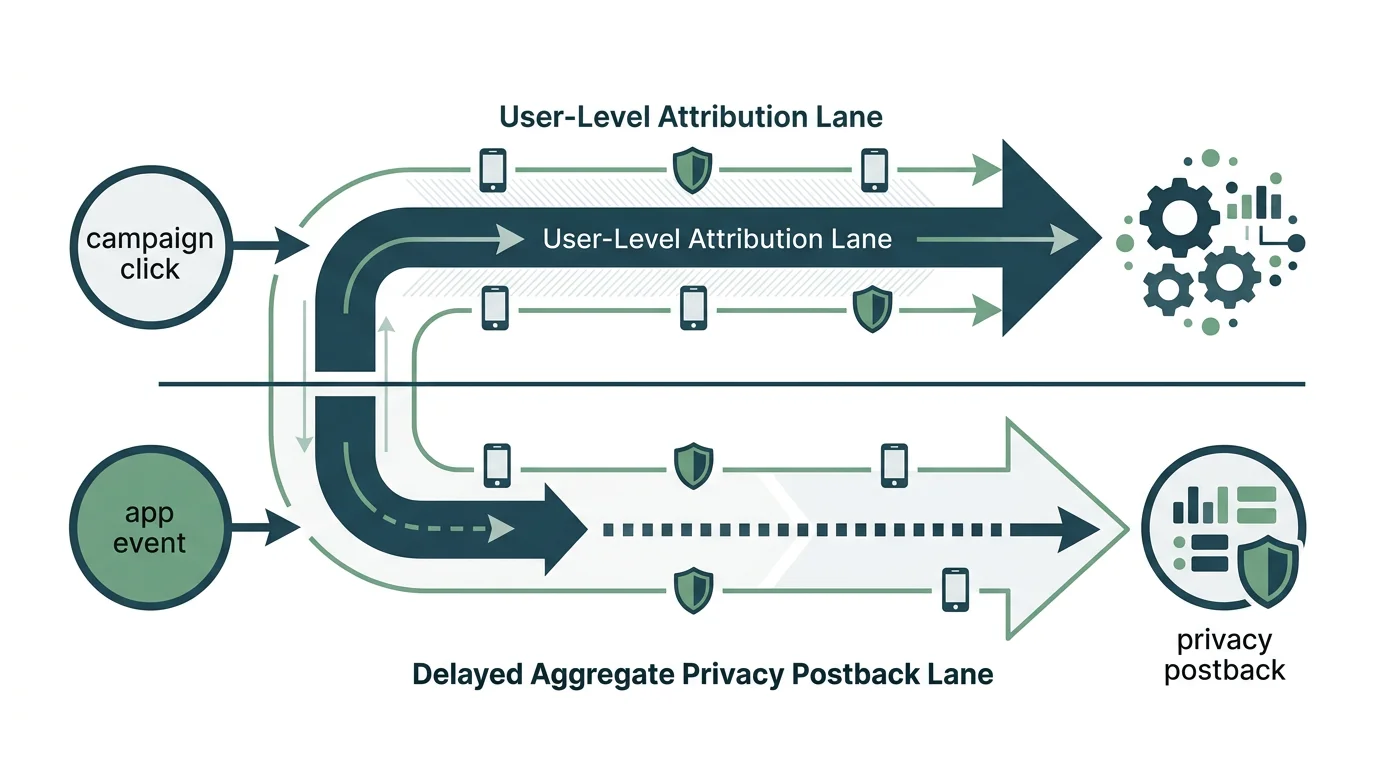
User-level attribution associates an eligible install or event with a marketing touchpoint under attribution rules. Available identifiers, consent, partner restrictions, and windows affect the match. An attributed outcome is a credit assignment—not an observed counterfactual showing what would have happened without the ad.
Privacy-framework aggregate postbacks
SKAdNetwork and AdAttributionKit provide privacy-preserving attribution signals. Their postbacks have their own timing, reporting fields, and privacy constraints. They do not provide unrestricted user-level journey reconstruction. Keep aggregate outputs distinct from individual attributed records, and do not sum overlapping measurement paths as separate acquisitions.
Product analytics
Product analytics examines what people do inside the app: onboarding completion, feature use, behavioral funnels, and retention. MMP event reporting connects acquisition credit with app outcomes. These systems can complement one another while counting different populations or using different event timing.
Deep-link routing
Deep linking concerns the user’s destination: opening a relevant app screen or carrying an intended destination through a deferred-link flow. Routing and measurement are separate acceptance tests. A link that opens the correct screen does not establish that the campaign received attribution credit.
Incrementality
Incrementality asks which additional outcomes marketing caused beyond the baseline. It needs an appropriate causal design, such as a randomized holdout or a well-designed geographic experiment. Reattributed users may have returned without advertising; attributed purchases may have happened anyway.
Different numbers become useful when each one has a defined job. Do not force every dashboard to match; make the differences explainable enough to support the next decision.
Implementation: define the events before installing the SDK
Give each conversion a business definition
Start with a measurement contract shared by growth, engineering, product analytics, and finance. Distinguish downloads, first opens, attributed installs, registrations, trials, and paying customers. Define how reinstalls and returning users enter reporting, including inactivity periods and reattribution windows.
For revenue, name the authoritative transaction record and specify currency, purchase time, trial-to-paid conversion, renewals, refunds, and duplicate handling. Realized revenue, recognized revenue, and modeled LTV are different measures. A purchase event alone is not a complete subscription accounting workflow.
Build an acceptance test, not just an installation task
- Record the implementation: app build, native or cross-platform SDK release, operating systems, and consent configuration.
- Test event delivery: names, parameters, timestamps, transaction identifiers, revenue, currency, and retries.
- Set event ownership: define which events originate in the app and which arrive server-to-server, with duplicate-prevention rules.
- Exercise acquisition and return: new install, reinstall, returning user, and eligible reattribution scenarios.
- Test routing separately: installed-app destinations, deferred links, and owned-media entry points.
- Trace partner feedback: event mappings, permissions, and the outcomes sent to each acquisition partner.
A successful SDK initialization is only one checkpoint. Backend purchase records, partner event delivery, link destinations, and reporting exports each need their own acceptance criteria.
iOS, Android, SKAdNetwork, and AdAttributionKit compatibility
Build a dated compatibility matrix from Adjust’s official iOS SDK documentation, Android SDK documentation, and product help materials. Minimum OS support, SDK support, privacy-framework coverage, and network readiness are separate requirements.
- iOS: list your supported OS releases, chosen SDK, ATT configuration, and behavior for different consent states.
- SKAdNetwork: document applicable framework versions, conversion-value mapping, postback handling, reporting windows, and available campaign granularity.
- AdAttributionKit: document OS and SDK prerequisites, required acquisition or re-engagement workflows, and participating network support.
- Android: document SDK requirements, install-referrer implementation, identifier availability, and relevant consent settings.
- Reporting: identify which outputs are observed, attributed, aggregated, or modeled, and how overlapping paths are treated.
Use release-specific documentation for the app build you plan to ship. A broad statement that a framework is supported is not a compatibility matrix for your implementation.
Network integration depth matters more than a partner count
List your actual acquisition partners—such as Meta, Google, TikTok, Apple Ads, and influencer or owned-media campaigns—and evaluate each workflow separately. A directory listing does not explain event feedback, cost access, campaign identifiers, or privacy-reporting coverage.
For every priority partner, the evaluation should cover install and event measurement, reattribution, click and view rules, campaign naming, account permissions, revenue feedback, reporting latency, and cost-data granularity. Include privacy-framework postbacks where relevant.
Use one representative acquisition campaign and one returning-user scenario. Compare the campaign identifiers and events through the app, MMP reporting, network reporting, and backend. Fraud filtering also needs an audit trail: covered threats, rejected activity, and how rejection affects partner reconciliation.
How to investigate conflicting numbers
Consider a campaign where the network reports installs, the store reports downloads, Adjust reports attributed installs, and the backend reports registrations. These are different stages and populations. A download may not become a first open; an install may not become a registration.
Before interpreting a variance as campaign failure, align:
- Date range, timezone, and whether the report groups by touchpoint or conversion date.
- Event definition, unique-user rules, and reinstall treatment.
- Attribution windows, view-through credit, and reattribution rules.
- Reporting delays and maturity of aggregate postbacks.
- Privacy restrictions, modeled values, and fraud exclusions.
Then judge campaign quality using comparable cohorts and downstream outcomes. Cheap installs are not necessarily valuable users. Retention, paid conversion, realized revenue, and payback need sufficient observation time. For the financial definitions, see our guide to calculating LTV.
Reporting and exports: require a usable sample dataset
A dashboard demonstration does not establish that your analyst can reproduce the numbers. Make sample exports part of the buying process and inspect the fields needed for your own campaign-to-value analysis.
- Accessible install, reattribution, event, revenue, fraud-rejection, and aggregate records.
- Available identifiers under each consent state and network restriction.
- Delivery methods, callbacks, APIs, storage destinations, and package entitlements.
- Refresh cadence, retention, historical access, limits, and retry behavior.
- Late events, corrections, deletion handling, currency, and timezone conventions.
Keep event-level data and aggregate privacy reporting distinguishable in your warehouse. Neither missing identifiers nor suppressed postback fields become observable simply because data is exported.
Adjust pricing and package evaluation
Use Adjust’s official pricing materials and a dated written proposal to define the commercial package. Compare the full cost of your required implementation, not just the headline platform fee.
The proposal should specify billing units, included usage, overages, required attribution and fraud capabilities, deep-linking scope, export access, retention, support, onboarding, contract duration, renewal, cancellation, and migration arrangements. Include any trial or evaluation terms in writing.
Keep technical requirements attached to the proposal. A feature described on a product page and a feature included in your package are different buying facts.
Strengths and tradeoffs
Adjust’s strongest fit is mobile-specific measurement infrastructure. App acquisition, returning-user credit, app events, linking, and privacy-framework reporting belong to the same operational problem. Teams moving beyond install volume can use defined downstream events to assess acquisition quality.
The tradeoff is ongoing implementation and interpretation work. SDK updates, partner settings, revenue quality, event governance, and privacy constraints remain important after launch. Fraud filtering does not eliminate every invalid interaction. Aggregate reporting does not deliver a complete individual journey.
Shortlist Adjust when you have meaningful mobile acquisition and engineering ownership. It is a weaker primary fit for web-only order attribution, behavioral analytics without an acquisition requirement, or a team expecting attribution reports to prove incremental growth.
Adjust alternatives: compare the same requirements
AppsFlyer, Singular, Branch, Kochava, and Tenjin are candidates for a mobile measurement shortlist. Compare them against identical scenarios rather than assuming every platform has the same reporting depth or package structure. Our AppsFlyer competitors guide provides additional category context.
| Requirement | Buying evidence |
|---|---|
| Attribution and events | New-install, returning-user, and revenue tests using shared definitions. |
| Privacy compatibility | Dated OS, SDK, framework, and network matrix. |
| Deep linking | Installed-app and deferred-routing acceptance results. |
| Partner coverage | Required event feedback, identifiers, cost data, and reporting granularity. |
| Data access | Sample exports and documented delivery and retention terms. |
| Total cost | Written package including implementation and required modules. |
Frequently asked questions
Is Adjust an MMP?
Yes. Adjust’s central role is mobile app attribution and measurement, including installs, reattribution, and defined in-app events.
Does Adjust support SKAdNetwork and AdAttributionKit?
Both are part of its privacy-oriented iOS measurement scope. Use release-specific developer documentation to build the OS, SDK, framework-feature, and network requirements for your app.
Can Adjust measure purchases and subscriptions?
In-app and server-to-server events are within its scope. Define purchase, renewal, refund, and revenue delivery explicitly. Event measurement and subscription accounting have different responsibilities.
Will every network report the same install count?
No. Definitions, attribution windows, reporting delays, privacy signals, and credit rules can create legitimate differences. Reconciliation starts with those differences rather than forcing totals to agree.
Does deep linking guarantee attribution?
No. Routing success and attribution credit are separate results. Test the destination experience and measurement independently.
Does Adjust attribution prove incremental revenue?
No. Attribution assigns credit. Incrementality evaluates additional impact through an appropriate causal design. MMM estimates aggregate contribution using historical data and model assumptions; it answers a different question again.
How should we evaluate Adjust pricing?
Match a dated written proposal to your volumes, required workflows, data access, and service needs. Compare complete packages across shortlisted MMPs.
Final decision: buy a defensible measurement workflow
Choose Adjust if it meets your app’s attribution, event, privacy, partner, and data-access requirements with reporting your team can explain. Make the decision around tested scenarios and dated technical and commercial requirements—not promises of perfect visibility.
The result you want is practical: a clear explanation of which campaigns receive credit, which cohorts produce value, which signals are still maturing, and which budget questions need an experiment rather than another attribution report.