
Reviews, Marketing Measurement

Rockerbox Review: Marketing Attribution, MMM, and Incrementality

A practical Rockerbox review explaining MTA, media mix modeling and incrementality, plus the data, implementation and fit questions buyers should verify.

Andrei Kholkin
Andrei Kholkin
October 7, 2026
Rockerbox Review: Marketing Attribution, MMM, and Incrementality

A paid-social dashboard cannot answer every question about TV, search, direct mail, and ecommerce revenue. Neither can a customer-journey report. This Rockerbox review focuses on the buying decision that matters: whether your team needs a coordinated measurement program across online and offline marketing, or simply a clearer attribution view.

Rockerbox brings together multi-touch attribution, marketing mix modeling, incrementality testing, and centralized marketing data. That breadth is most relevant when teams need to understand recorded journeys, plan channel budgets, and assess additional outcomes. Those are three different jobs, with three different kinds of evidence.

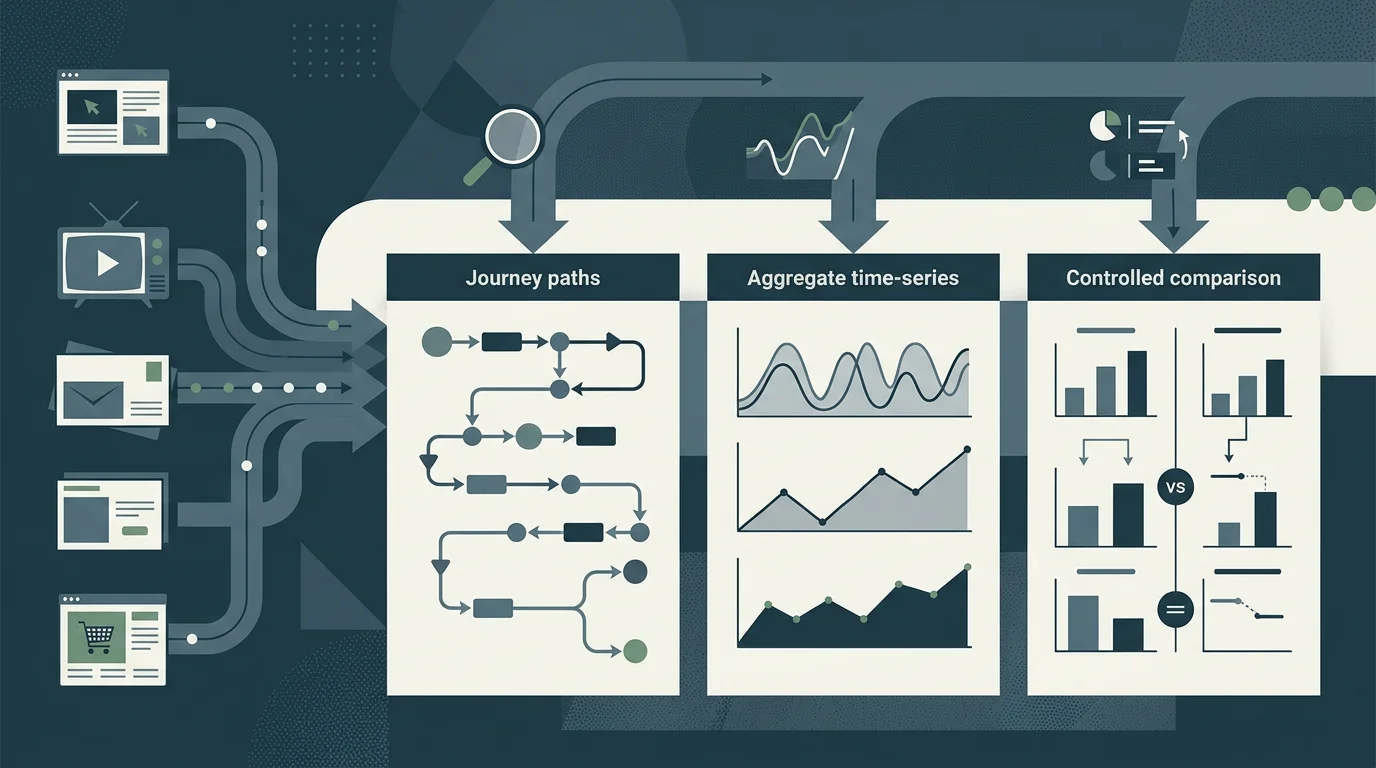
Conceptual illustration of multi-channel marketing measurement across online and offline channels.
Editorial illustration: journey credit, aggregate contribution, and counterfactual lift provide different perspectives on marketing performance.

What is Rockerbox?

Rockerbox is a marketing-measurement platform combining MTA, MMM, incrementality testing, online/offline measurement, and data workflows. The practical distinction from basic ad analytics is the range of decisions it addresses: granular journey analysis, strategic allocation, and causal testing.

Evaluate that scope as a measurement program, not a feature checklist. A connection that imports costs does a different job from exposure matching. An offline channel represented in an aggregate model does a different job from a touchpoint represented in an individual journey.

For account-level scope, the useful starting points are Rockerbox’s product materials, its documentation, and a written proposal describing your deliverables. The key question is: which methods, inputs, channels, and services belong to our proposed account?

MTA, MMM, and incrementality: what each establishes

MTA: allocated credit across observed journeys

Multi-touch attribution distributes conversion credit among recorded, eligible interactions. It helps explain the journeys your data captures and the channel or campaign patterns within those journeys. The allocation depends on the attribution approach, eligibility rules, and available signals.

A purchase following a search click and social interaction establishes a recorded sequence—not the amount of additional demand either interaction caused. Missing exposures, identity gaps, and consent-related signal loss can change the visible journey and its allocated credit.

Account coverage questions:

  • Which clicks, impressions, events, and offline interactions enter our journeys?
  • Which interactions are observed, matched, or modeled?
  • How are identity, attribution windows, view-through credit, and duplicate conversions handled?
  • At what channel, campaign, or placement granularity can we act?

MMM: aggregate modeled contribution

Marketing mix modeling analyzes historical aggregate inputs to estimate how marketing and other factors relate to business outcomes over time. It can support channel budgeting where individual exposure-to-purchase matching is unavailable or insufficient.

The estimates depend on model specification and input quality. Channels whose spending moves together are difficult to separate. Promotions, price changes, distribution, seasonality, and underlying demand also affect revenue. A contribution estimate is not automatically experimental evidence of causality.

Account coverage questions:

  • What historical depth, frequency, spend variation, and outcome data does our model need?
  • Which channels, markets, and contextual variables enter the model?
  • How are validation, uncertainty, refresh schedules, and changes in business conditions addressed?
  • Which planning outputs and analytical support are included?

Incrementality: causal lift against a counterfactual

Incrementality asks what an intervention added relative to what would have happened without it. A suitable control group or another defensible counterfactual provides the comparison. The objective is additional outcomes, not reassigned credit for existing conversions.

Credible inference requires a sound design, adequate statistical power, and consistent execution. Spillover, market differences, concurrent campaigns, and treatment contamination can weaken the comparison. An inconclusive estimate is not the same as evidence of no effect.

Account coverage questions:

  • Which test designs are available for our intended channels and geographies?
  • Who owns counterfactual selection, power analysis, execution, and interpretation?
  • What budget, outcome volume, and duration does the test require?
  • How are uncertainty and the limits of applying results beyond the tested conditions communicated?

Attribution assigns credit. MMM estimates aggregate contribution. Incrementality estimates additional outcomes against a counterfactual. Agreement is useful; disagreement can also reveal something important.
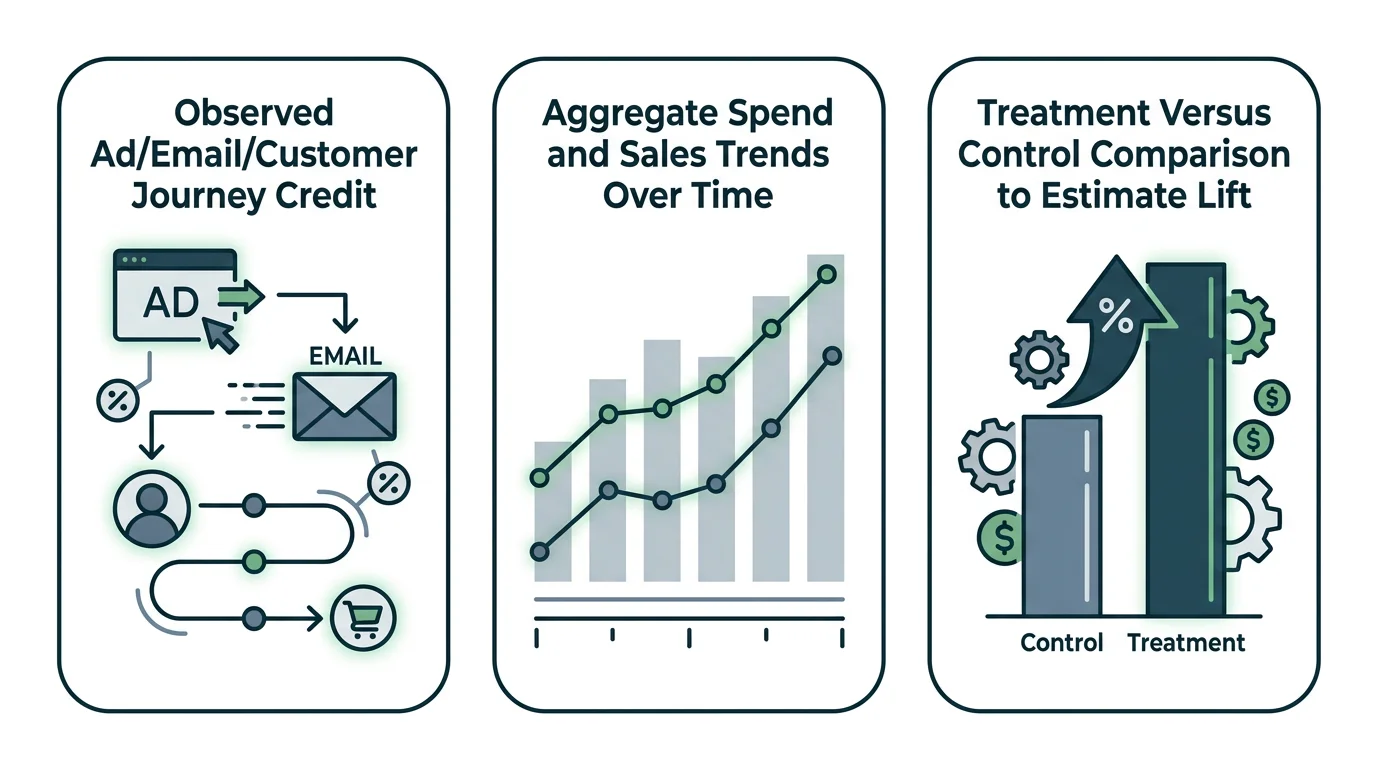
Comparison diagram of multi-touch attribution, marketing mix modeling, and incrementality testing.
The evidence behind each method determines how its output should inform a decision.

Online and offline coverage: define what “measured” means

For TV, CTV, podcasts, direct mail, retail, or other offline activity, separate four possible jobs: importing spending, representing an exposure, estimating aggregate contribution, and testing incremental impact. One does not establish the others.

Build a channel-by-method map. For each material channel, record the input source, granularity, geography, history, refresh schedule, and business outcome. Ask how promotional codes, surveys, matched exposures, and aggregate feeds are used in the proposed scope.

Choose the method by the decision
DecisionPrimary evidenceMain interpretation limit
Investigate recorded conversion pathsMTA journey creditVisible paths are not causal lift
Evaluate channel budgets over timeMMM contribution estimatesSpecification and inputs shape estimates
Assess additional outcomes from an interventionIncrementality studyInference depends on the counterfactual and design

For example, paid search may receive substantial journey credit while a test estimates less incremental revenue. Search can capture existing demand as well as influence purchases. The outputs address different quantities; averaging them into a single “true ROAS” obscures that distinction.


Who is Rockerbox best for?

Stronger potential fit: multichannel organizations with meaningful offline investment, recurring budget-allocation decisions, and reliable spending and outcome records. Internal analytics, data-engineering, or agency support can help turn the platform’s broader scope into a sustainable workflow.

Multiple markets or business units also make consistent definitions valuable. But organizational complexity creates extra work: different revenue systems, currencies, taxonomies, and ownership structures need a deliberate implementation plan.

Weaker potential fit: teams seeking only a straightforward ecommerce attribution dashboard, businesses with unreliable revenue records, or organizations unable to support model review and experiment execution. Company size alone is not the deciding factor. A well-prepared smaller team can be more measurement-ready than a large organization with fragmented data ownership.

Strengths and tradeoffs

The appeal of a broader measurement approach

  • Complementary evidence: journey analysis, aggregate modeling, and testing address different blind spots.
  • Online/offline perspective: measurement can extend beyond interactions visible in web journeys.
  • Shared data preparation: aligned channel and outcome definitions reduce avoidable reporting differences.
  • Operational and strategic decisions: campaign analysis and longer-horizon planning can belong to the same measurement program.

The work that comes with it

  • Ongoing ownership: sources, taxonomies, reconciliation, and interpretation need accountable people.
  • Different cadences: attribution reports, model updates, and experiments answer questions on different schedules.
  • Persistent uncertainty: centralizing data does not remove missing signals, model assumptions, or experimental limitations.
  • Scope management: platform access, custom pipelines, analytical support, and testing assistance should be explicit proposal items.

The strongest business case is not “more measurement features.” It is a set of important decisions that becomes more defensible through those features.

Data readiness and implementation requirements

Start with the decisions and work backward to the data. Each input needs an owner, a definition, and an acceptance criterion.

  1. Define the business outcome. Specify orders, qualified leads, closed revenue, or another result. Document gross versus net revenue, returns, cancellations, currencies, and time zones.
  2. Inventory source coverage. Map advertising, commerce, CRM, web, offline, and custom feeds. Record permissions, historical gaps, update frequency, and source-level granularity.
  3. Standardize the taxonomy. Align channel, campaign, geography, and business-unit definitions. Establish how naming changes and new channels will be maintained.
  4. Prepare method-specific inputs. MTA needs usable events and journey matching. MMM needs consistent aggregate history and relevant context. Incrementality needs an executable intervention and credible comparison.
  5. Reconcile before interpreting. Compare imported spending and outcomes with authoritative records. Define handling for duplicates, late events, revised costs, and refunds.
  6. Design downstream access. Include required exports, APIs, warehouse destinations, schemas, retention, and ownership in the account scope.
  7. Assign governance responsibilities. Review consent, processing terms, access controls, regional obligations, and security requirements with the responsible teams.

A phased rollout reduces confusion: establish source quality, validate one decision workflow, then expand. Useful acceptance criteria include reconciled totals, documented coverage, understandable outputs, and a named owner for exceptions—not simply a live dashboard.

Questions for the implementation plan

  • What must our team build, maintain, and supply?
  • Which connections and event types belong to the proposed account?
  • What historical backfill is included, and what remains unavailable?
  • How are identity rules and channel mappings documented?
  • Who investigates discrepancies between methods or source systems?
  • What refresh cadence and support responsibilities apply to each deliverable?

Rockerbox pricing: scope the whole operating cost

Build the pricing comparison around a written proposal, not a generic starting figure. A useful proposal connects price to the measurement scope your organization will operate.

  • Methods: which MTA, MMM, and testing deliverables are included?
  • Scale: how do channels, markets, business units, users, and data volume affect cost?
  • Implementation: what onboarding, custom data work, and historical preparation are included?
  • Services: what analyst involvement, model interpretation, and experiment assistance are included?
  • Access: what export, API, warehouse, and retention rights belong to the account?
  • Commercial terms: what contract duration, renewal, expansion, and termination provisions apply?

Separate recurring platform fees from project and service fees. Include your internal operating effort in the business case. A lower subscription with substantial data-engineering work can be a different purchase from a package with clearly assigned implementation responsibilities.

Rockerbox alternatives: compare the measurement need

Rockerbox’s broad positioning makes category fit especially important. A specialist tool may solve one part of the problem without replacing the wider measurement program.

  • Calls, forms, and CRM revenue: evaluate lead-to-revenue attribution workflows.
  • Shopify reporting and profitability: evaluate ecommerce-focused analytics.
  • Affiliate operations: evaluate partner tracking, commissions, and program management.
  • App acquisition: evaluate mobile measurement partners.
  • Daily ecommerce attribution: evaluate a narrower attribution-clarity platform.

Weberlo fits the last comparison when growing ecommerce teams need real-time attribution clarity without enterprise complexity. That is a narrower job than Rockerbox’s combined MTA, MMM, testing, offline-measurement, and warehouse scope. A simpler attribution workflow should be judged on its usefulness for that job—not treated as equivalent measurement methodology.

Practical buyer FAQs

What is the difference between Rockerbox MTA and MMM?

MTA allocates credit within observed conversion journeys. MMM estimates contribution from aggregate historical inputs. They differ in granularity, assumptions, and evidence. Neither output alone establishes experimentally measured incremental revenue.

Does Rockerbox measure TV, CTV, direct mail, and podcasts?

Rockerbox’s scope includes online and offline measurement. For your account, ask which of these channels enters MTA, MMM, or testing, through which data source, and at what granularity. Aggregate spending coverage and identified exposure coverage are different deliverables.

Are all three methods included in every account?

Define that in the proposal: which modules, release status, deliverables, services, and ongoing support are included? A broad product description should become an account-specific scope of work.

How much historical data does MMM need?

The useful requirement depends on the outcome, channel mix, geography, frequency, and available variation. Request a data-readiness assessment for your intended model. Length of history alone does not compensate for inconsistent definitions or channels that always move together.

Does Rockerbox prove incremental revenue?

Attribution allocates credit; it does not prove lift. A well-designed incrementality study can estimate additional revenue against a credible counterfactual. Establish whether the proposed study measures revenue or another outcome, and how uncertainty will be reported.

How long does implementation take?

Plan the timeline around source access, historical preparation, reconciliation, method configuration, and acceptance testing. The practical buying question is which milestones apply to your data and who owns each one.

Can the data connect to our warehouse or BI workflow?

Warehouse connectivity is part of Rockerbox’s broader data scope. Ask which destinations, datasets, refresh schedules, schema commitments, export limits, and access rights belong to your account. Match them to the reporting workflow your data team needs.

What if the methods disagree?

First align outcomes, time periods, populations, channels, and revenue definitions. Then investigate differences in evidence and assumptions. MTA credit, MMM contribution, and test lift need not match; disagreement can be informative rather than a reporting defect.

Final verdict: buy a decision workflow

Rockerbox is a strong candidate to evaluate when online/offline complexity warrants coordinated journey attribution, aggregate planning, and causal testing. Its value depends on usable inputs, explicit account scope, and people who can interpret and act on the evidence.

Before choosing, define the channel-by-method coverage map, implementation ownership, analytical deliverables, and full operating cost. The goal is not three performance numbers in one place. It is better-supported decisions.

Read Next

Marketing Attribution
Blog

Marketing Attribution

Marketing Attribution Models: Mapping the Customer Journey to Maximize ROI

Andrei Kholkin October 3, 2024
How to Allocate Marketing Budgets Across Channels
Guides

How to Allocate Marketing Budgets Across Channels

How to Allocate Marketing Budgets Across Channels: Effective Strategies for Maximum ROI

Andrei Kholkin January 18, 2024
B2B Marketing Attribution
Blog

B2B Marketing Attribution

B2B Marketing Attribution: Strategies for Measuring Campaign Effectiveness

Andrei Kholkin January 8, 2024