Ruler Analytics Review: From Calls and Forms to Revenue
Evaluate Ruler Analytics for connecting marketing touchpoints, calls and forms to CRM outcomes—and learn what to validate about matching, setup and revenue reporting.
Andrei Kholkin
October 7, 2026
Verdict: Ruler Analytics is a strong shortlist candidate for lead-generation and sales-led teams whose marketing produces enquiries but whose revenue arrives later through a CRM. Its value is connecting recorded website journeys, calls, forms, and chats with downstream sales outcomes. That makes it more relevant to a business selling consultations or demos than to a team seeking only an ad-spend dashboard.
The central buying question is operational: can your business connect a captured enquiry to the correct contact, opportunity, and revenue value? This Ruler Analytics review for 2026 focuses on that workflow, the records it depends on, and the decisions its reporting can support.
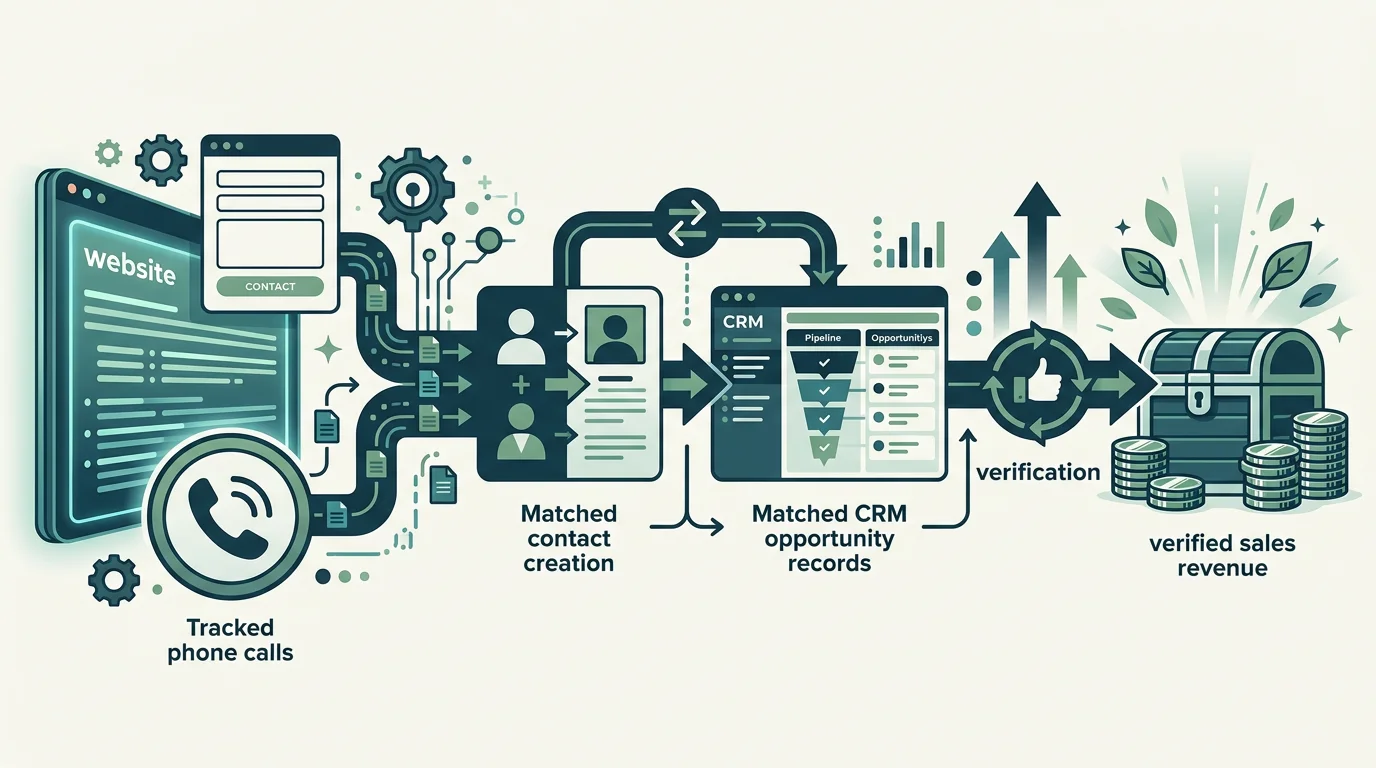
Editorial illustration: the marketing-to-revenue journey.
What is Ruler Analytics?
Ruler Analytics is a visitor-level marketing attribution platform. Its scope includes first-party website tracking, dynamic call tracking, form and live-chat tracking, ecommerce conversions, CRM opportunity and revenue feedback, and multi-touch attribution.
The distinction from basic campaign reporting is where measurement ends. A form submission may count as an advertising conversion, but it does not tell a sales-led business whether the person became a qualified opportunity or a paying customer. Ruler connects those stages through captured lead information and supported business-system connections.
For teams working on B2B marketing attribution, that downstream view is useful. Visitor-level measurement, however, is different from understanding an entire buying committee. One deal can involve several contacts, devices, and conversations.
How the website-to-revenue workflow works
1. Capture eligible website activity
Tracking captures available source and campaign context alongside website activity. Eligible visits are those that the installed tracking can observe under the site's consent settings and available signals. Missing campaign parameters, untracked pages, and separate devices can leave gaps.
First-party tracking helps establish a website-level measurement foundation. It does not make all visitors identifiable or create a record of activity outside the configured collection process.
2. Capture calls, forms, and chats
Ruler's dynamic call tracking uses dynamic number insertion to connect tracked website activity with telephone enquiries. Number configuration and call routing are part of that workflow. A call to an untracked number does not acquire website context simply because the business uses call tracking elsewhere.
Forms and chats provide another route from website activity to a lead identity. The meaningful event is the completed enquiry, not merely a button click. Embedded forms, schedulers, repeat submissions, and existing contacts all belong in implementation testing.
3. Match the lead to business records
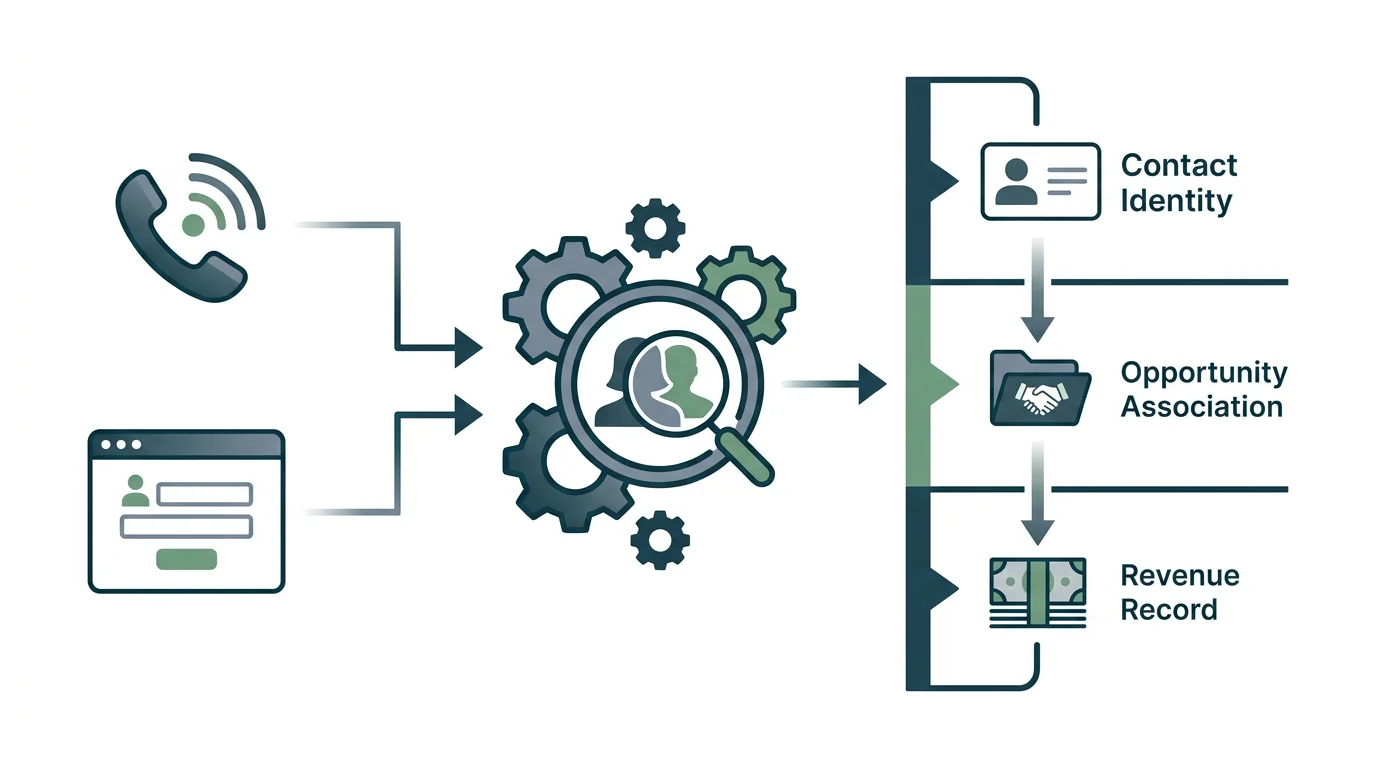
Captured contact details connect the tracked journey with CRM records through the supported matching workflow. This step has two distinct jobs: identifying the contact and associating that contact with the relevant sales opportunity.
An email match alone does not resolve which of several opportunities belongs to an enquiry. Equally, an opportunity can include multiple contacts whose journeys differ. Those relationships need consistent CRM ownership.
4. Feed sales outcomes into attribution
Opportunity stages and closed-revenue information supply the downstream outcome. Revenue becomes available to marketing reporting when the configured connection delivers those records. Ruler also supports sending revenue information to selected marketing and analytics systems.
This process depends on sales updates and data movement. A deal that closes weeks after an enquiry will not appear as closed revenue at the time the lead is created. Historical campaign performance can therefore evolve as opportunities progress.
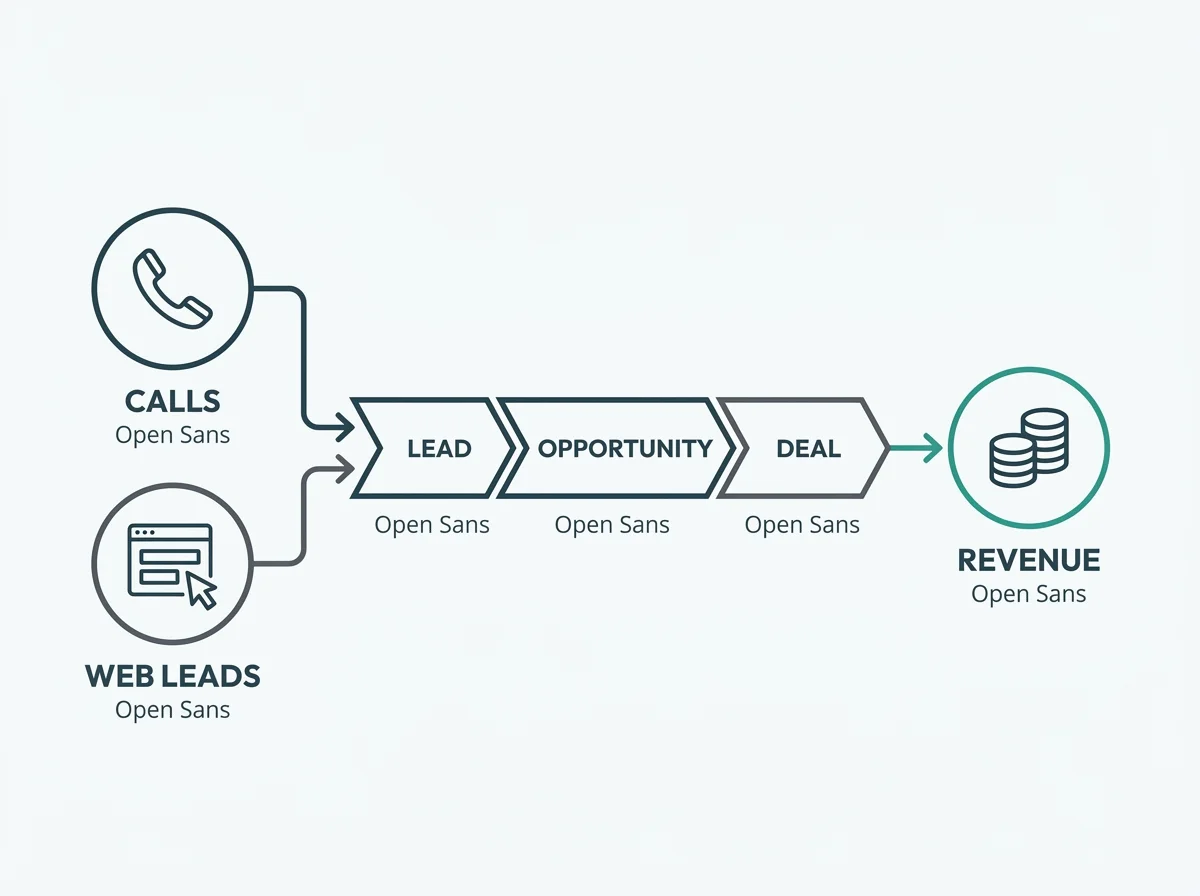
Test the complete chain: enquiry → contact → opportunity → revenue. A working website tag is only the beginning.
Identity matching and CRM hygiene
A buyer might research on a personal phone, submit a work email from a laptop, and call from a shared office number. Another colleague might sign the contract. These are separate identity and association challenges, not just tracking events.
Shared numbers, duplicate contacts, different email addresses, and multiple opportunities can complicate matching. Unobserved visits cannot become observed history through CRM cleanup alone. Conversely, good tracking cannot repair a sales record that lacks the relevant contact relationship.
Contact ownership: establish how duplicate records and repeat enquiries are handled.
Opportunity ownership: associate the relevant contacts with the correct deal.
Stage definitions: use consistent meanings for qualified, open, won, and lost.
Revenue ownership: name the team responsible for amounts, currencies, and corrections.
Exception ownership: assign responsibility for unmatched records and failed data flows.
A practical implementation needs marketing, sales operations, and finance to agree on these definitions. Otherwise, two campaigns can appear different because their leads receive different CRM treatment rather than because one produces better customers.
Attribution windows and revenue definitions
An attribution window determines which earlier touchpoints remain eligible for credit. Data retention determines how long records remain available. These are different settings: retained history does not necessarily mean every historical interaction receives credit.
For a long sales cycle, the evaluation should address the window used for lead creation, opportunity progression, and eventual revenue attribution. Also distinguish acquisition date from close date. Revenue from leads acquired this month is not the same population as revenue booked this month.
Agree on the revenue measure before comparing channels:
Pipeline value: an open opportunity amount, not a completed sale.
Booked value: a signed deal's value, potentially including future payments.
Collected revenue: payments received.
Recurring value: monthly, annual, and total contract amounts are distinct.
Map the chosen measure to the supported data flow. Refunds, reopened deals, cancellations, and value changes belong in the test plan. Compare attribution totals with the same CRM or finance population, date basis, and currency treatment.
Attributed credit is not causal lift
Ruler's attribution models include first-click, last-click, linear, and position-based approaches. Each allocates credit differently across eligible recorded touchpoints. A model change can change channel credit without changing a single sale.
Attribution: which recorded touchpoints receive credit for an outcome?
Incrementality testing: what additional outcome did a marketing intervention cause relative to a suitable baseline?
Marketing mix modeling: how does aggregate marketing activity relate to outcomes over time under the model's assumptions?
These methods answer different questions. A matched journey establishes an association; it does not establish what would have happened without the campaign. Use attribution to investigate performance and inform decisions, not as a standalone counterfactual.
Our attribution-model overview explains the credit-allocation differences. Treat advanced modeling and standard journey attribution as separate requirements in the buying scope.
Who is Ruler Analytics best for?
Strong fit: sales outcomes matter more than lead counts
Ruler is especially relevant to B2B businesses with CRM pipelines, professional services, agencies reporting customer acquisition, and high-consideration purchases involving calls or consultations. It suits teams that need to understand which recorded marketing journeys connect with qualified opportunities and revenue.
The strongest operational fit is a business with maintained sales records and someone responsible for integration health. Marketing needs access to downstream outcomes, and sales needs to supply them consistently.
Weaker fit: the problem is elsewhere
A team needing only basic call reporting has a narrower requirement. A business without reliable sales-stage or revenue updates first needs to improve its CRM process. Ecommerce stores focused on merchandising, product performance, retention, or repeat-purchase cohorts should evaluate those needs separately from lead-to-revenue attribution.
Ruler supports ecommerce conversion tracking, but its lead-to-revenue workflow addresses a different buying problem from Shopify-centered operational analytics.
Strengths and practical tradeoffs
Downstream visibility: connecting leads with revenue helps distinguish low-cost enquiries from commercially useful enquiries.
Multiple enquiry types: calls, forms, and chats belong in one journey evaluation rather than isolated reports.
CRM feedback: sales outcomes extend reporting beyond the initial conversion.
Implementation effort: capture, matching, routing, and field mapping require coordinated setup.
Ongoing governance: website changes and CRM process changes can affect the measurement chain.
Delayed outcomes: long sales cycles make recent revenue comparisons incomplete.
Integrations and setup: evaluate the event flow
Ruler's integration scope includes Salesforce and HubSpot, form tools such as Calendly, Typeform, and Gravity Forms, chat providers including Intercom and Drift, and ecommerce and payment systems. Integration selection should start with the required records and events—not a collection of logos.
Which lead, contact, opportunity, and revenue records move through the connection?
Which fields identify contacts and associate them with opportunities?
What data moves in each direction?
How are historical records, failed transfers, retries, and corrected values handled?
Which team owns configuration changes and connection monitoring?
What refresh schedule does the business need for its reporting decisions?
For calls, include number allocation, routing, regional requirements, and missed-call treatment. For forms and chat, include successful capture, repeat enquiries, embedded tools, and contact-field consistency. For CRM revenue, include stage mapping, the won-status trigger, and the amount that reporting should use.
Data ownership and what the workflow cannot observe
The CRM should have a clear role as the business record of sales outcomes. Attribution reporting then connects eligible marketing history with those outcomes. Finance remains responsible for defining the financial measure being reconciled.
Data ownership also includes access. Your requirements should cover exportable fields, journey and outcome detail, retention, user permissions, access after termination, and the ability to reconcile reports outside the attribution interface. These are buying requirements, not interchangeable with having dashboard access.
The observable journey has practical boundaries:
A visit outside configured tracking lacks the same captured context.
A call outside tracked number routing may lack a website association.
A trade-show conversation or sales email needs its own business-data workflow.
A different device or identifier can separate interactions belonging to one person.
A colleague's involvement may not be associated with the same opportunity.
A missing CRM update leaves the downstream outcome unavailable to that data flow.
Editorial diagram: capture, matching, and outcome reporting are distinct parts of the workflow.
Representative end-to-end validation checklist
Use a controlled test enquiry that follows your actual sales process. Record the expected campaign, contact, opportunity, and revenue value so each stage can be reconciled.
Start with a tagged visit. Follow the real landing-page path and test the site's consent behavior.
Create an enquiry. Submit a form, place a tracked call, or complete a supported chat. Include unsuccessful submissions and missed calls as separate cases.
Inspect the captured lead. Compare the event and marketing context with the expected enquiry.
Inspect the CRM record. Follow a new contact and an existing contact through the workflow. Include duplicate and shared-identifier cases.
Create and associate an opportunity. Include a contact with multiple deals and a deal with multiple contacts.
Progress the sale. Move it through defined stages and close it with a known amount and currency.
Reconcile attributed revenue. Compare the relevant records, date basis, window, and model with the expected outcome.
Test supported corrections. Include a changed amount, reopened opportunity, or cancellation in the applicable workflow.
Document exceptions. Record unmatched enquiries, failed transfers, and missing context, with an owner for each issue.
Set acceptance criteria around correct event capture, correct opportunity association, duplicate treatment, and financial reconciliation. A single successful match is not a substitute for representative edge cases.
Ruler Analytics pricing in 2026
Ruler's pricing is indicative and depends on monthly traffic, product scope, data, and integration requirements. A useful budget therefore needs a scoped commercial proposal rather than a universal starting figure.
Traffic bands and the treatment of usage above the allowance.
Call volumes, numbers, and associated charges.
Required CRM and other business-system connections.
Attribution models, data activation, and advanced modeling scope.
Retention, exports, reporting access, and users.
Implementation, onboarding, support, contract term, and cancellation.
Compare total operating cost, including internal setup and ongoing record maintenance. The lowest platform fee is not necessarily the lowest-cost way to obtain useful revenue reporting.
Alternatives: choose by measurement need
CallRail, WhatConverts, and CallTrackingMetrics belong in a call-and-form-focused comparison set. Rockerbox addresses broader online/offline measurement with attribution, marketing mix modeling, and incrementality testing. Lebesgue is centered on ecommerce analytics. Trackier focuses on partner programs, while Adjust focuses on mobile-app measurement.
These categories are not interchangeable. Begin with the conversion journey and the decision you need to make.
Ruler Analytics FAQs
What does Ruler Analytics track?
Its scope includes website journeys, forms, calls, chats, ecommerce conversions, and CRM-linked opportunities and revenue. The reporting population depends on the configured tracking and connections.
Can Ruler connect form fills to closed revenue?
Yes, through the lead-capture, matching, opportunity-association, and revenue-feedback workflow. A form submission alone does not contain the eventual sale outcome.
Does Ruler work with Salesforce or HubSpot?
Both are part of its integration scope. Your implementation needs defined fields, contact relationships, opportunity stages, and revenue values.
Can it attribute phone calls to campaigns?
Dynamic call tracking connects calls with captured marketing context through configured numbers and routing. Calls outside that tracked flow need separate treatment.
How long does setup take?
Setup effort depends on website capture, phone configuration, forms, CRM mapping, and testing. Plan around completion of the end-to-end workflow rather than tag installation alone.
Will every lead match?
Missing signals, different identifiers, shared numbers, and duplicate records can complicate or prevent matching. Include unmatched records in reconciliation and operational review.
Does Ruler prove that a channel caused a sale?
No. Attribution allocates credit among eligible touchpoints. Causal lift requires additional evidence, such as an appropriately designed experiment.
Is it suitable for ecommerce?
Ruler supports ecommerce conversion tracking. Product analytics, retention, cohorts, and merchandising are separate requirements from its lead-to-revenue workflow.
Bottom line
Shortlist Ruler Analytics when calls, forms, and chats begin a sales process that your CRM can reliably describe. Its strongest use case is connecting marketing activity with downstream business outcomes—not simply adding another lead dashboard.
Choose around capture coverage, matching quality, consistent sales records, meaningful revenue definitions, and an economical implementation scope. If your primary need is ecommerce attribution clarity, request a Weberlo demo to explore that measurement layer.