

An affiliate program can record a sale correctly and still pay the wrong commission. The referral might belong to another partner, the order might be duplicated, or a refund might arrive after approval. A useful partner platform needs to make those decisions traceable—not simply display a conversion total.
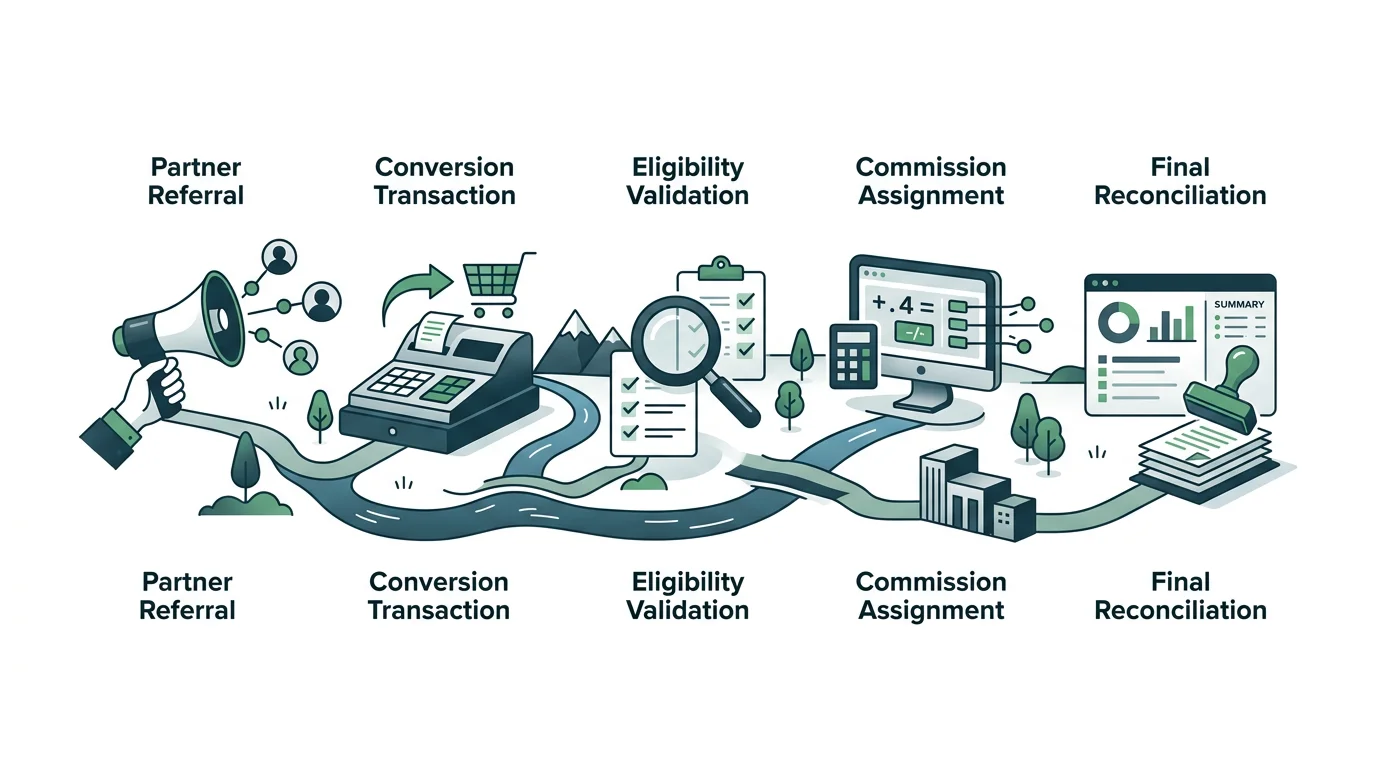
This 2026 Trackier review focuses on that operational job: identifying referrals, connecting them to qualifying actions, assigning partner credit, and reconciling compensation. For advertisers, agencies, networks, and program operators, these are the questions that determine whether tracking software fits the business.

What is Trackier?
Trackier is a partner and performance-marketing platform for affiliate, influencer, publisher, and partner campaigns. Its appeal is the combination of tracking and operational functions: managing campaigns and partners, recording activity, reporting performance, and supporting commission workflows.
That makes it a different buying category from a general marketing analytics dashboard. An operator needs to know which partner receives credit, whether a conversion qualifies, and how the decision affects compensation. The core evaluation is therefore partner attribution plus program administration.
Commission eligibility and marketing contribution are separate
Imagine a customer clicks a paid search ad, returns through an email, and then purchases through a publisher’s referral link. Your affiliate agreement can make that publisher eligible for commission. A marketing attribution model can allocate credit across several touchpoints. An experiment can investigate whether the publisher generated additional purchases.
Commission rules answer “Who should be paid under this agreement?” Incrementality asks “What additional outcome did this activity cause?”
Attribution assigns credit. Incrementality testing investigates causal lift. Marketing mix modeling estimates aggregate contribution. Those methods answer different questions, and none substitutes for a clearly defined commission policy. Keep partner compensation records separate from broader marketing-credit calculations.
Who is Trackier best for?
- Advertisers and brands: Teams running structured affiliate or referral programs with defined qualifying actions.
- Agencies: Operators handling several advertiser programs and needing clear reporting and responsibility boundaries.
- Networks: Businesses coordinating offers, publishers, conversion review, and compensation.
- Partner-program managers: Teams spending significant time reconciling tracking records, partner disputes, and commission decisions.
Trackier is a stronger candidate when the partner relationship and conversion event are explicit. For example, an advertiser paying for approved leads needs to distinguish submitted leads from accepted leads. A retail referral program needs to distinguish placed orders from commissionable orders.
It is a different evaluation for businesses whose main requirement is call-to-CRM revenue matching, mobile install measurement, or ecommerce-wide customer-journey analysis. Keep those needs outside the partner-platform scorecard unless they are part of your actual operating workflow.
How to evaluate the partner conversion lifecycle
1. Identify the referral
Start with the connection between a partner and the referred visitor or action. Map where the referral identifier enters your systems and where it must survive: redirects, landing pages, forms, checkout, and the advertiser backend.
The implementation questions are concrete: Which tracking connection carries the identifier? What happens when it is missing? How are two eligible partner referrals resolved? Does your program need coupon-based identification or cross-device behavior? Treat each as a separate requirement rather than assuming basic click tracking covers it.
2. Submit the authoritative conversion
Choose the system that owns the qualifying action. For an order, that might be the transaction backend; for a lead, it might be the system that accepts or rejects the application. A page visit is not automatically evidence that the business event occurred.
Define a submission contract: unique transaction ID, event type, timestamp, referral identifier, value, currency, and status. Which fields does the connection accept? What happens after a failed submission? Can the same event be delivered again without creating another commission? These questions belong in the technical pilot.
3. Validate the business event
Recording a conversion and accepting it for compensation are different steps. Your validation policy should cover customer eligibility, excluded products, lead acceptance, payment status, cancellations, and any waiting period before approval.
Assign an owner to every decision. Who rejects an invalid lead? Who processes a cancellation? Who resolves a disputed referral? Fraud controls add another review layer, but business eligibility still needs explicit rules and evidence.
4. Apply partner-credit rules
Write down the expected winner before testing. Include competing partners, expired referral windows, repeat customers, and interactions that your agreement excludes. A report that names a partner is useful only when your team can explain why that partner received credit.
For any attribution-model requirement, separate reporting from compensation. Does the model change analytical credit, payable commission, or both? A multi-touch analysis does not necessarily imply split commissions.
5. Reconcile the commission lifecycle
Calculate an expected commission independently from your written agreement. Then compare it with the recorded transaction, partner-credit decision, validation status, and commission output.
Keep calculation, approval, invoicing, and payment distinct. A calculated commission is not a completed payout. Your workflow should identify where each step happens, who owns it, and which record finance uses to establish payment status.
Duplicates, reversals, and disputes: the important edge cases
Duplicate delivery is an event-handling problem; competing partner claims are a credit-allocation problem. Test them separately. Reusing the same transaction ID should exercise your intended duplicate policy, while two referral identifiers should exercise your partner-credit rules.
Reversals introduce a third problem: a previously eligible conversion changes after the fact. Include full cancellations, partial refunds, rejected leads, and chargebacks wherever they affect your program.
- What happens when a reversal arrives before commission approval?
- What happens after approval, invoicing, or payment?
- How does a partial refund affect the commission basis?
- Can operators and finance trace the original amount and subsequent adjustment?
- Which reporting period contains the adjustment?
- What evidence is available when a partner disputes the change?
Reporting: build a reconciliation view, not just a leaderboard
Partner rankings help operators identify activity, but reconciliation requires record-level explanations. Define what clicks, conversions, approved conversions, revenue, and commission mean before comparing reports.
Sales revenue, advertiser payout, and partner commission are different amounts. A report labeled “revenue” needs a precise business definition. Refund treatment, currency handling, and reporting dates also affect whether finance and operations can reproduce the totals.
- Traceability: Can required outputs connect a conversion to its source transaction and partner?
- Status: Can your workflow distinguish recorded, accepted, rejected, and adjusted events?
- Timing: How are late submissions and backdated adjustments represented?
- Access: Which information should partners, clients, operators, and finance see?
- Extraction: Which fields and historical records does your reconciliation process need?
An affiliate platform and an advertising platform can both credit the same purchase without the underlying order being duplicated. That is overlapping attribution, not necessarily duplicate event ingestion. Our marketing attribution guide explains how credit allocation differs from counting business outcomes.
Trackier strengths and tradeoffs
The strongest reason to consider Trackier is its partner-operations focus. Campaign management, tracking, reporting, commission workflows, and fraud controls address connected operating tasks. That scope is relevant when compensation accuracy and partner relationships matter alongside acquisition performance.
The tradeoff is implementation responsibility. Your team still needs event definitions, ownership of validation, consistent identifiers, commission terms, and reversal procedures. Bringing those tasks into a platform does not remove the need to govern them.
Integration fit should be evaluated by data flow, not connection count. Which events move in each direction? Are updates included? Who maintains the connection? A summary-data import and a transaction-level conversion feed solve different problems.
Fraud review also needs operational discipline. Detection and filtering are different from final adjudication. Include legitimate traffic in your pilot alongside suspicious scenarios so the team can assess review evidence and the consequences of false positives.
Trackier pricing and commercial requirements
Build the commercial scorecard around your expected workload and required workflow. A starting price alone does not describe the operating cost of a partner program.
- What is the platform fee and billing term?
- Which events count toward usage, and how are overages charged?
- What limits apply to partners, programs, users, or domains?
- Which API, reporting, export, fraud-control, and permission requirements are included?
- What implementation, migration, and support work is included?
- What are the renewal, cancellation, and data-extraction terms?
- What scope and limits apply to any pilot or trial?
Use Trackier’s official site, product documentation, and a written proposal as the purchasing materials. Keep the price, usage assumptions, required functionality, and implementation responsibilities together in the decision record.
Hands-on Trackier pilot checklist
Run a small, controlled test before transferring a live program. Prepare a reference ledger containing source transaction IDs, referral history, expected eligibility, expected partner, commission basis, and expected amount. These are test expectations—not performance results.
- Normal conversion: Send an eligible event with a known referral. Trace it from submission to the expected commission record.
- Duplicate and retry: Deliver the same transaction again, including a retry after a simulated connection failure. Inspect record counts and compensation.
- Competing referrals: Introduce two partners in a known sequence. Compare the outcome with the written credit policy.
- Missing or expired identifier: Exercise the intended fallback and attribution-window rules.
- Eligibility boundary: Include an excluded product, rejected lead, or repeat customer when those distinctions affect payment.
- Reversal: Process a cancellation and any material partial-refund scenario. Repeat at different approval stages.
- Commission calculation: Compare every tested rule with an independently calculated amount, including currencies and rounding.
- Access and reporting: Review operator, finance, client, and partner views against their intended responsibilities.
- Reconciliation: Export the required records and reproduce totals from the reference ledger.
- Migration rehearsal: Plan the cutover date, treatment of open commissions, historical access, and ownership of ongoing maintenance.
Pass criterion: Every sampled transaction has an explainable referral, eligibility outcome, partner-credit decision, commission amount, and adjustment history. Log unexplained differences with an owner and resolution before moving the program.
Trackier alternatives: stay within the operating category
For affiliate and partner-program operations, comparison directions include Everflow, TUNE, impact.com, and PartnerStack. Apply the same event ledger, compensation requirements, reporting needs, and pilot scenarios to each shortlist candidate.
The better choice is the one that fits your program’s actual lifecycle. Do not substitute a general attribution dashboard for partner administration simply because both products use the word “tracking.”
Trackier FAQs
Is Trackier affiliate tracking software?
Yes. Its partner and performance-marketing scope includes affiliate click and conversion tracking alongside campaign management, reporting, and commission workflows.
Does Trackier cover influencer and publisher campaigns?
Influencer and publisher campaigns are within its partner-oriented scope. The buying questions are how referrals are identified, which actions qualify, and how each partner’s compensation is handled.
What should a team prepare before setup?
Prepare conversion definitions, the authoritative event source, referral and transaction identifiers, credit rules, commission terms, approval ownership, and reversal procedures. Setup effort follows the complexity of those workflows.
How should duplicates and refunds be tested?
Submit the same transaction more than once, then exercise cancellations and partial refunds at different commission stages. Compare conversion counts, commission amounts, and adjustment records with the source ledger.
Does a credited affiliate conversion prove incremental revenue?
No. It establishes credit under the implemented rules. Incrementality requires a causal measurement approach, such as an appropriately designed experiment.
Does commission tracking mean payment is complete?
No. Calculation, approval, invoicing, and payment are separate stages. Document the system and owner responsible for each stage in your program.
How should buyers compare Trackier pricing?
Compare the proposed fee, usage definition, overages, required functionality, implementation, support, and contract terms against expected program activity.
What is the most important migration requirement?
A reconciled cutover. Define how existing referrals, open conversions, unpaid commissions, and historical reporting will be handled so no transaction falls between the old and new workflows.