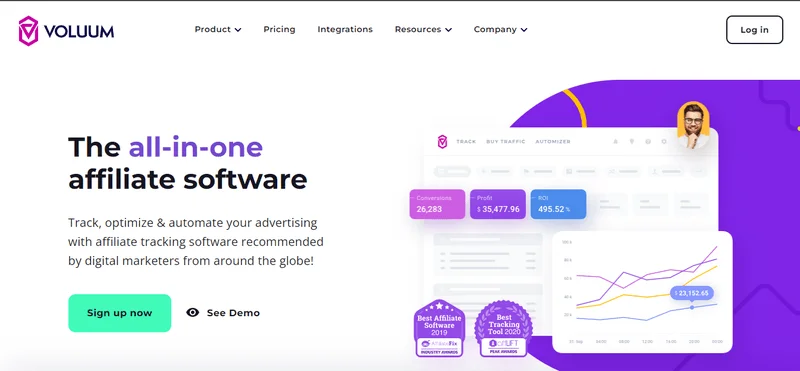
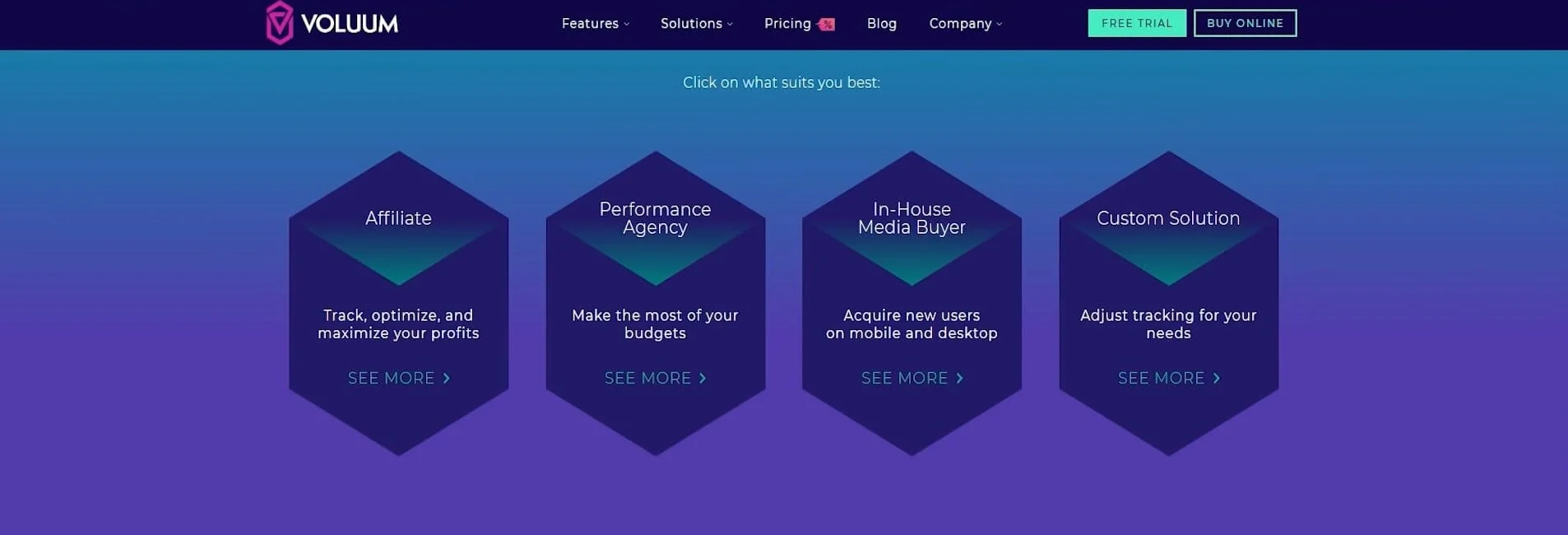
Voluum is a strong fit for affiliate marketers and performance media buyers who need campaign tracking, conversion reporting, traffic routing, and optimization in one cloud-based platform. Its value is clearest when you actively test offers and landing pages, manage paid traffic, and use campaign data to guide changes. The trade-offs are event-based pricing, plan-specific limits, and integration capabilities that differ by connection.
If your main question is which campaign, offer, or path deserves more traffic, Voluum’s feature set aligns with that job. If you primarily need affiliate-program management or cross-channel revenue attribution, start with that requirement rather than treating every tracking product as interchangeable.
An overview of Voluum
Voluum is a cloud-based ad-tracking and affiliate-tracking platform. It tracks paid and organic traffic, records campaign events, and provides tools for distributing traffic and optimizing performance campaigns.
It is not an affiliate network that supplies offers, or an ad platform where you buy traffic. Its role is to connect campaign activity with conversion outcomes and support decisions about the traffic you already manage. That makes it more focused on campaign operations than a general web analytics tool.
What are the key features of Voluum?
The feature set falls into three useful groups: tracking, optimization, and automation. Reporting and team controls support all three.
Tracking: campaign events and conversion outcomes
Voluum supports both redirect tracking and direct tracking. Redirect tracking routes a visitor through a tracking URL; direct tracking records activity without a tracking redirect. The appropriate method depends on the campaign’s destination and traffic-source requirements.
Tracked events include impressions, visits, clicks, conversions, and custom conversions. Server-to-server, or S2S, postback tracking lets a connected system send conversion information back to the tracker. Paid and organic traffic tracking are both supported.
Real-time reports attach more than 30 data points to tracked events. Those reports provide detail for comparing campaign performance and investigating differences between traffic segments, offers, and paths.
Optimization: routing and testing traffic
Voluum includes A/B testing for offers, landing pages, and paths, alongside rule-based traffic distribution and AI-powered traffic distribution. These are operational tools for deciding where traffic goes, not just reporting features.
- A/B testing supports comparisons between campaign destinations and paths.
- Rule-based distribution routes traffic according to configured conditions.
- AI-powered distribution adds an automated approach to traffic allocation.
The practical benefit is a closer connection between measurement and action: you can use campaign outcomes to inform routing and testing decisions. These tools do not make every campaign profitable; offer economics, acquisition costs, and conversion performance still determine the result.
Automation and traffic controls
Automizer supports automation, automatic rules, cost synchronization, and supported platform integrations. With full API integrations, Voluum can retrieve cost data, control campaigns, and create automatic rules.
Anti-fraud features, bot filtering, IP and user-agent rules, and traffic controls address suspicious or unwanted traffic. These belong in the campaign-quality workflow rather than serving as a blanket promise of data security.
Purpose and benefits of ad tracking with Voluum
Voluum’s central purpose is to make performance campaigns measurable and actionable. For an affiliate buyer, that means connecting traffic and acquisition costs with recorded conversions and revenue, then deciding which offers or paths to keep testing.
For an agency or operator, the same workflow extends to reporting and collaboration. Workspaces, role-based access, shared reports, APIs, and MCP access support different ways of working with campaign data.
The strongest reason to consider Voluum is the combination of tracking and traffic optimization—not an expectation that reporting alone will improve ROI.
Its benefits are most relevant when your team makes frequent campaign-level decisions. A business that only needs a high-level channel report has a different job to solve from a buyer distributing traffic between multiple affiliate offers.
How campaign setup works in Voluum
Campaign setup is best understood as connecting the traffic source, tracking method, destination, conversion signal, and cost data. The structure matters more than a list of interface clicks.
- Define the campaign structure: identify the traffic source, landing pages, offers, and paths you need to report on.
- Choose the tracking method: use direct or redirect tracking to suit the campaign flow.
- Connect conversions: configure conversion tracking, including S2S postbacks where that is the chosen method.
- Connect costs: establish how spend enters the reporting workflow, including cost synchronization on supported integrations.
- Add optimization logic: set up tests, routing rules, and automation around the decisions you intend to make.
Integrations and compatibility
Voluum connections use either templates or full API integrations. That distinction is important: a tracking template and a full integration do not provide the same depth of functionality.
A template supports connection setup and tracking parameters. Full API integrations can retrieve costs, control campaigns, and support automatic rules. Conversion postbacks serve another purpose: sending conversion outcomes back to the tracker. API access to reporting data is also distinct from control over an advertising platform.
Build your requirements around these separate functions. Tracking compatibility alone does not establish cost synchronization, campaign control, or identical postback behavior across every connection.
How Voluum tracks campaigns
In a typical affiliate campaign, traffic enters through the configured tracking flow and continues to a landing page or offer. Event identifiers connect recorded activity with the conversion information returned to Voluum. Reports then bring together tracked events, conversion outcomes, and available cost data.
That creates a cycle: capture traffic, record conversions, compare performance, and adjust destinations or rules. Direct tracking changes the entry mechanism, while redirect tracking introduces a tracking redirect into the visitor’s path.
For evaluation, focus on whether that cycle matches your operation. A team testing several offer paths needs different functionality from a team reporting on a long customer journey across marketing channels.
Is Voluum hard to use?
The setup involves campaign concepts such as tracking parameters, conversion identifiers, postbacks, paths, and traffic-source connections. Familiarity with those concepts is more useful than a broad claim that the software is easy or difficult.
Experienced affiliates and media buyers will recognize the workflow. A newcomer has two things to learn: how performance tracking works and how to represent their campaigns within the platform. Voluum offers a 14-day platform preview without payment details, providing a way to explore its structure.
Cloud deployment and migration considerations
Voluum is cloud-based, so it is not a self-hosted tracker. Deployment model matters if controlling your own tracking infrastructure is a core requirement.
Campaign-data migration through CSV is supported under specified structural constraints. Moving data and reproducing a live campaign workflow are separate tasks: domains, campaign structures, postbacks, and reporting definitions also need a transition plan.
- Map existing campaigns, offers, landing pages, and tracking identifiers to the new structure.
- Plan domain and postback changes before redirecting live traffic.
- Preserve historical reports needed for period-to-period comparisons.
- Align conversion definitions, currencies, and reporting periods.
- Run parallel tracking on a controlled portion of traffic before completing the move.
Access controls and traffic protection
For team operations, Voluum provides workspaces, role-based access, and shared reports. These features help organize access to campaign data and reporting.
For traffic quality, bot filtering and IP/user-agent rules support monitoring and control. Keep those two categories separate: controlling suspicious traffic is a different function from managing who can access your account and reports.
Voluum pricing and plan limits
Voluum’s annual-billing examples begin at the following monthly prices:
| Plan | Monthly price |
|---|---|
| Profit | $119 |
| Scale | $299 |
| Start-up | $539 |
| Agency | $799 |
| Enterprise | $1,599 |
Pricing is usage- and plan-dependent. Relevant allowances include active campaigns, events, domains, data retention, users, workspaces, and Automizer usage. Feature availability also depends on the plan.
An event can be a visit, click, conversion, or impression; 10 impressions count as one event. Tracking continues after the included event allowance is exceeded, with overage charges applying. Budgeting therefore requires an estimate of total tracked activity, not just conversions or ad clicks.
The meaningful comparison is the cost of a plan that accommodates your traffic volume, campaign structure, reporting history, and team. The entry price alone does not describe that operating cost.
Final verdict: who should consider Voluum?
Voluum is worth considering when you need campaign tracking and traffic optimization together. Affiliates testing offers, media buyers managing performance traffic, and agencies needing campaign reporting and access controls have clear reasons to evaluate it.
It is a less direct fit when your primary requirement is affiliate-network or publisher management, self-hosting, or broad cross-channel revenue attribution rather than campaign routing. Event economics and plan-specific retention or collaboration limits can also shape the decision.
Weberlo is a different fit for the overlapping need to understand cross-channel revenue attribution and make clearer marketing decisions. It is not a drop-in replacement for Voluum’s tracking, routing, or traffic-optimization workflows. For switching decisions, explore our Voluum alternatives for different tracking and pricing needs.
Frequently asked questions
What is Voluum used for?
Voluum is used to track affiliate and performance campaigns, record conversion outcomes, report on performance, test destinations, distribute traffic, and automate supported campaign actions.
Is Voluum an affiliate network?
No. Voluum is a tracking and optimization platform, not an affiliate network. It measures and manages campaign activity rather than supplying an offer marketplace.
How much does Voluum cost?
Annual-billing examples start at $119 per month for Profit. Total cost depends on the plan, tracked event volume, included allowances, and overages.
Does Voluum support postback tracking?
Yes. Voluum supports server-to-server postback tracking for conversion reporting.
Can Voluum track organic traffic?
Yes. Voluum supports both paid and organic traffic tracking.
If your priority is cross-channel revenue attribution and decision clarity, request a Weberlo demo to explore that different fit.