Assess Lebesgue’s Shopify-focused marketing analytics and learn which features, metrics, integrations, and plan limits to verify before buying.
Andrei Kholkin
October 7, 2026
Lebesgue is worth shortlisting when your Shopify team needs more than campaign attribution. Its ecommerce-centered scope brings together store performance, advertising analysis, customer value and recommendations. The attraction is a more connected view of the business; the tradeoff is that connected reports still need consistent revenue definitions, complete cost inputs and well-maintained tracking.
This Lebesgue review focuses on the buying decisions that matter in 2026: which reporting problems it addresses, how to reconcile the numbers, and where a broader merchant-analytics workspace differs from a dedicated attribution tool.
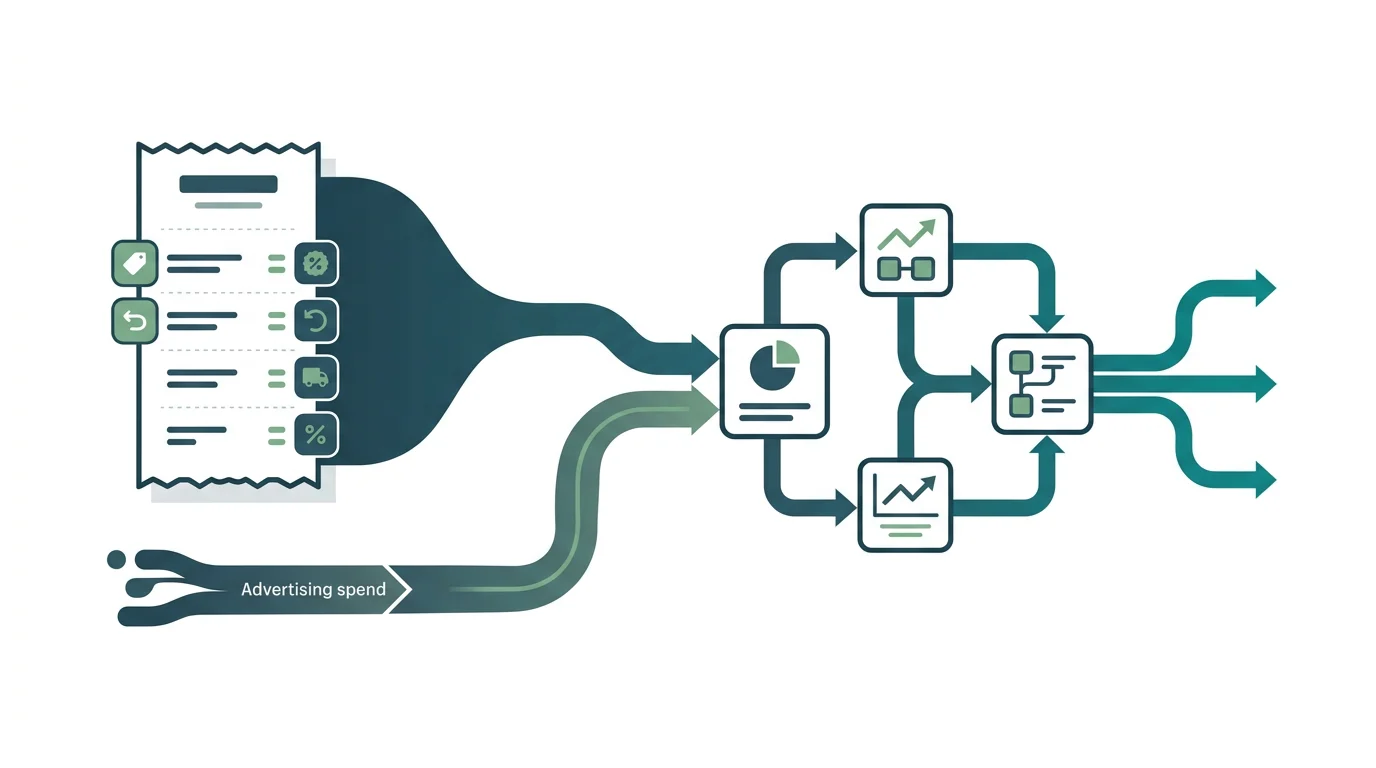
Orders, customer history and marketing activity provide different inputs for acquisition, margin and retention decisions.
What is Lebesgue?
Lebesgue is an ecommerce marketing analytics and optimization platform centered on Shopify, with WooCommerce support also in its scope. It combines commerce and marketing reporting with attribution, customer-value analysis, advertising audits and AI-generated insights.
That makes it a different evaluation from a simple ad dashboard. A merchant’s questions extend beyond “Which campaign received credit?” to “Did the orders leave enough margin?” and “Did those customers purchase again?” Lebesgue’s appeal is bringing those questions into one ecommerce-oriented workspace.
The value—and limits—of combining store and marketing data
Your store records purchases and customer history. Advertising platforms report spend and their own conversion results. Email tools add another view of engagement and purchasing. Connecting these sources reduces spreadsheet work and makes discrepancies easier to investigate.
But a shared workspace is not automatically a shared definition. Store sales can include refunds differently from advertising conversion values. Campaign reporting can use a different time zone or conversion window. Customer records can contain duplicate identities. The useful result is an explainable view of performance, not a requirement that every source display the same number.
A connected dashboard is valuable when it makes differences understandable—not when it hides them behind a single total.
Who is Lebesgue best for?
Lebesgue belongs on the shortlist for Shopify merchants running several marketing channels and wanting advertising results alongside store performance. It is particularly relevant when profitability, repeat orders, cohorts or creative analysis influence how the team allocates budget.
Lean merchant teams: consolidation and guided analysis can reduce reporting effort.
Growing ecommerce brands: customer value and margin provide context that platform ROAS alone lacks.
Teams with reliable operational inputs: clean order records, customer definitions and product costs make deeper analysis more useful.
It is a weaker category fit for businesses whose main measurement problem is phone calls progressing to CRM deals, mobile app installs, affiliate commission operations or complex offline media. It can also be excessive if your only need is a basic spend summary.
Attribution and first-party tracking
Lebesgue’s scope includes first-party tracking and attribution models. Their practical value depends on the journey being measured: available touchpoints, conversion events, identity matching and the window used to assign credit.
For your buying requirements, separate the questions a report should answer:
Credit allocation: which channels receive credit under the chosen model?
Journey detail: which interactions are connected to an order?
Customer context: does the order belong to a first-time or repeat customer?
Missing signals: how are orders without an associated touchpoint displayed?
Historical order data and historical journey data are different assets. Importing old purchases does not reconstruct interactions that were never collected. First-party tracking also does not remove consent requirements or make every cross-device interaction observable.
Use a consistent model and window when comparing campaigns. Switching models changes credit allocation; it does not change the number of orders the store received. Our attribution models overview explains the main approaches.
Attributed credit is not incremental impact
An attributed order is a purchase assigned to a marketing interaction under a rule or model. Incrementality asks how many additional purchases marketing caused beyond what would have happened without it. A returning customer can generate attributed revenue even when some purchasing would have occurred anyway.
Marketing mix modeling addresses another question: how aggregate marketing activity and other factors relate to outcomes over time. Attribution, MMM and experiments complement one another, but they are not interchangeable. An attribution report alone does not establish causal lift.
Profitability, LTV and recommendations
Profitability needs explicit costs
Lebesgue’s ecommerce reporting includes profitability analysis. The meaningful question is which costs the business includes in its interpretation: product costs, fulfillment, shipping, payment fees, returns and marketing expenditure.
A positive figure after product costs and ad spend is not necessarily accounting net profit. Fixed overhead and other operating costs may sit elsewhere. Define the result you need before treating a profitability dashboard as the basis for scaling spend.
Customer value needs a horizon
LTV, retention and cohort analysis help distinguish short-term acquisition efficiency from longer-term customer value. Their usefulness depends on whether the value is observed or projected, whether it is revenue or margin, and how much time customers have had to repurchase.
Compare cohorts at equivalent ages. Six-month customer value is a fairer comparison between acquisition groups than accumulated value from a two-year-old cohort versus a recent one. See our LTV calculation guide for the underlying distinctions.
Recommendations support decisions; they do not prove them
Advertising audits, creative analysis, competitor intelligence and AI recommendations broaden Lebesgue’s scope beyond reporting. A useful recommendation identifies a business question, shows the supporting inputs and suggests an action the team can evaluate.
Keep observations, benchmarks and predictions separate. Competitor intelligence provides context; it is not equivalent to access to another merchant’s complete economics. A suggested budget change should connect to your margins, acquisition targets and testing process rather than become an automatic instruction.
For MMM-related analysis, define the strategic decision, historical data requirements and internal ownership of interpretation. Aggregate modeling serves a different purpose from investigating an individual order.
Integrations and setup: build a usable data flow
Lebesgue’s integration scope includes Shopify, WooCommerce, Meta Ads, Google Ads, TikTok, Klaviyo, Amazon and GA4. A platform connection is the starting point; the important detail is the data your workflow requires from it.
Commerce: order IDs, statuses, customer records, products, variants and refund history.
Advertising: account coverage, spend, campaign identifiers, currency and reporting dates.
Email and analytics: campaign naming, event definitions and links between traffic and purchases.
Tracking: installation ownership, consent behavior, conversion events and duplicate-event handling.
Operations: permissions, connection maintenance, refresh timing and access to usable exports.
Shopify and WooCommerce are separate implementation environments. Build your setup requirements around your actual store, not around an assumption that every commerce connection has identical behavior.
Six metric-definition pitfalls to resolve
Use a metric dictionary for your evaluation. Record the revenue base, costs, customer population, time period and attribution method. The following are business definitions for comparison, rather than product-specific calculations.
Metric
Definition pitfall
Revenue
Gross product sales, net sales and collected order totals differ. Discounts, refunds, taxes and shipping change the base.
Profit
Gross profit, contribution profit and net profit subtract different costs. A missing cost input must not become an assumed zero.
ROAS
Attributed revenue divided by ad spend depends on the credit source, window and revenue definition. Different platforms can credit the same order.
MER
Total revenue divided by defined marketing spend changes when the denominator includes only media or broader marketing costs.
CAC
Acquisition costs divided by new customers requires a consistent new-customer definition and an explicit cost scope.
LTV
Observed versus projected value, revenue versus margin, and different time horizons produce different answers.
For example, $20,000 in defined store revenue and $5,000 in media spend produce a paid-media MER of 4. If a model credits $12,000 to that advertising, attributed ROAS is 2.4. Neither number establishes profit or incremental revenue. Our MER versus ROAS guide explains how to use both lenses.
Reconcile a sample order before trusting the summary
Start with a fixed reporting period and a small set of orders: a first-time buyer, a repeat buyer, a discounted purchase, a cancellation and a partial refund. Follow each order from the commerce record into revenue, customer and attribution reporting.
Those figures answer different questions. A report showing $70 and a payment record showing $88 can both be correct. The reconciliation should explain the $18 difference rather than force the totals together.
Now examine timing. If the order falls in September and the refund in October, decide whether your reporting should restate September or record the refund in October. Align time zones and currencies before comparing daily totals. Keep the same order ID throughout the exercise.
A discounted, partially refunded order produces different product-revenue, cash and contribution figures.
Then reconcile the attribution
For the same order, inspect the linked touchpoints and allocated credit. Determine whether the report uses the initial $100 product value or the post-refund $70 value. Keep order attribution separate from the cost calculation: campaign-level spend allocation is not automatically an order-level accounting expense.
Repeat this exercise for customers with multiple orders. A repeat purchase should not become a newly acquired customer merely because it has a new advertising interaction.
Setup checklist for a useful evaluation
Choose two decisions: for example, which acquisition channels deserve investigation and whether new-customer cohorts retain enough value.
Align dates and currencies: use the same period, time zone and reporting currency across source records.
Reconcile commerce totals: trace orders, discounts, cancellations and refunds to their source records.
Reconcile spend: separate complete reporting days from delayed imports and identify every included account.
Document customer rules: define first purchase, repeat purchase and duplicate customer handling.
Inspect tracking: follow purchase events, consent behavior and duplicate-event handling through a controlled order.
Assign ownership: identify who maintains connections, product costs, permissions and reporting definitions.
Lebesgue pricing and package scope
Evaluate the package as a whole, not just the headline subscription fee. The commercial scope should match the analysis your team actually needs.
Core access: stores, advertising accounts, users and historical data.
Measurement: attribution, tracking components and reporting depth.
Customer analytics: LTV, cohorts, retention and profitability inputs.
Intelligence: AI usage allowances, creative analysis and competitor tools.
Advanced analysis: MMM-related functionality and implementation support.
Commercial terms: billing period, usage thresholds, separate charges, cancellation and data access after cancellation.
Lebesgue’s official website is the destination for its pricing and package information. Use the written order form and subscription terms as the basis for your budget, including the features and allowances attached to the purchased package.
Alternatives: compare the right measurement layer
Lebesgue’s breadth is an advantage when merchant analytics is the job. Other categories serve different operating models:
Compare Lebesgue for its ecommerce analytics breadth and Weberlo for its attribution-clarity role. Weberlo focuses on accurate, real-time attribution clarity for growing ecommerce teams without enterprise cost or complexity.
If store operations, competitor intelligence, creative audits or AI recommendations are essential, keep those as separate buying requirements. If your immediate need is to understand marketing credit and make clearer daily decisions, evaluate Weberlo’s integrations, attribution approach and pricing against that narrower job.
Frequently asked questions
Is Lebesgue Shopify-only?
No. It is Shopify-centered, and its scope also includes WooCommerce. Your commerce platform should shape the implementation requirements and reporting evaluation.
Does Lebesgue provide marketing attribution?
Yes, attribution and first-party tracking are part of its product scope. Model choice, tracking inputs and revenue definitions determine how the resulting credit should be interpreted.
Can profitability and LTV help beyond ROAS?
Yes. They add cost and repeat-purchase context. Their usefulness depends on explicit cost coverage, consistent customer identities and a defined value horizon.
How much setup work should a merchant plan for?
Plan for source connections, tracking configuration, permissions, cost inputs and sample-order reconciliation. The required work grows with the number of channels and the depth of analysis.
Does a named integration mean all required data is connected?
No. Spend totals, order records, customer history and touchpoint details are different datasets. Define the fields needed for each decision.
How should AI recommendations be used?
Use them to prioritize investigation and possible tests. Connect each suggested action to its evidence, your business economics and a measurable outcome.
Does attributed revenue prove incremental sales?
No. Attribution assigns credit. Incremental impact requires a causal evaluation, such as a suitably designed experiment.
Bottom line: buy for the decision, not the dashboard
Lebesgue is a relevant candidate for Shopify-centered teams wanting marketing results alongside profitability and customer value. Its breadth is useful when those questions matter—and less useful when the team only needs a narrower attribution view.
Build the decision around reconciled orders, understandable metrics, manageable setup and a package that covers your needs. For real-time ecommerce attribution clarity, request a Weberlo demo with your marketing sources and the decisions you want to improve.