

Best Stape alternative for revenue attribution: Weberlo. Best like-for-like sGTM host: TAGGRS or Addingwell.
For ecommerce marketers whose job is attribution clarity, campaign-to-revenue visibility, and better budget decisions—not managing an sGTM host—Weberlo is the lead recommendation. Grounded in unified store revenue and cross-platform ad-spend reporting, server-side attribution, deduplication, campaign-to-creative visibility, and AI-assisted analysis to guide budget optimization, Weberlo solves the downstream measurement challenge. Stape provides server-side event delivery and sGTM hosting; Weberlo operates downstream as an attribution and revenue-measurement platform. They are adjacent layers of the marketing stack, not identical products. Weberlo is not an sGTM host and does not replace event-delivery infrastructure—an ecommerce buyer can choose Weberlo for attribution and separately keep or select an event tracking host when their technical setup requires one. (If you are evaluating both tools directly, see our detailed Weberlo vs. Stape comparison.)
Weberlo overview: Best suited for ecommerce teams and direct-to-consumer brands that need unified store revenue reporting, cross-platform ad-spend consolidation, deduplicated attribution, and campaign-to-creative visibility to inform budget decisions. Honest limitation: Weberlo is an attribution and revenue-measurement platform, not an sGTM host. It does not host custom Google Tag Manager server containers, so a separate tracking host is needed only if the buyer's stack requires one.
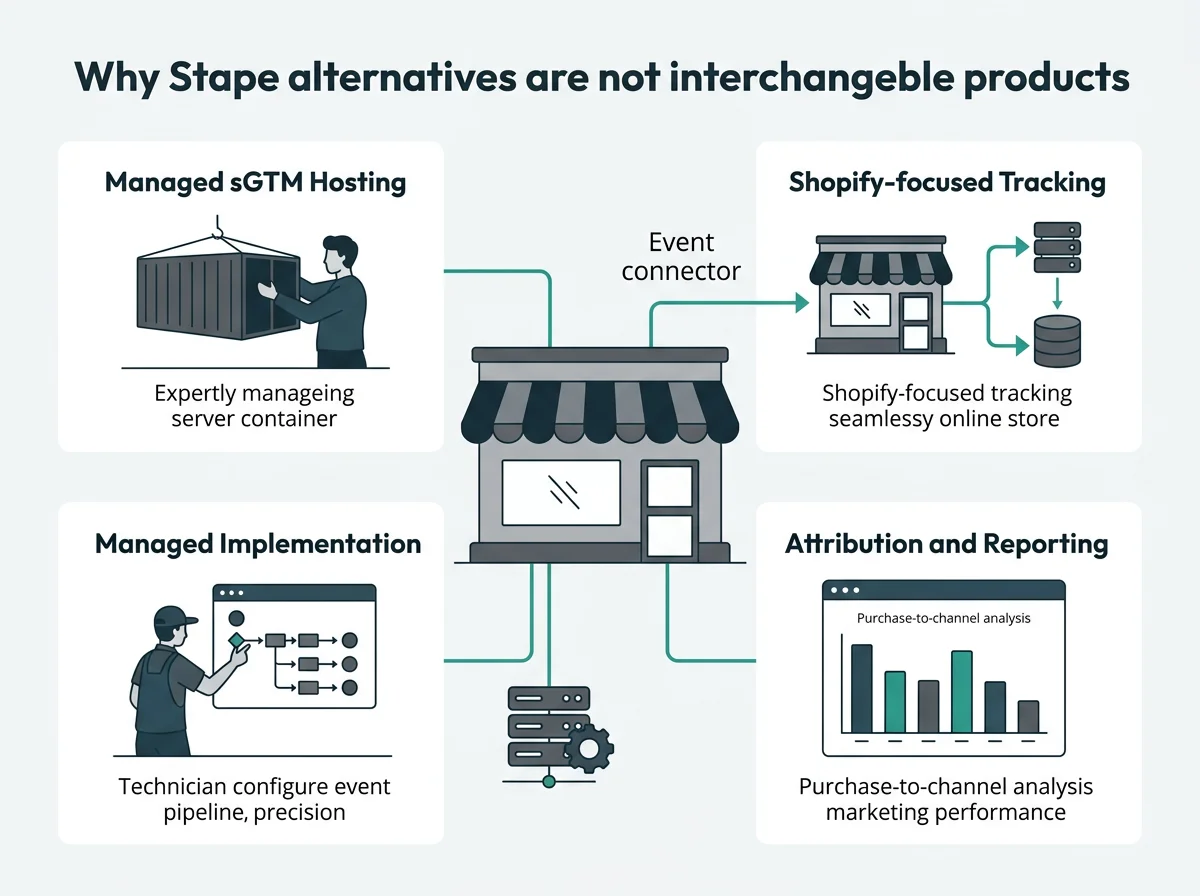
For ecommerce teams, the first decision is not which vendor has the longest feature list. It is whether you need a downstream revenue attribution platform, a managed tracking pipeline, or a hosting environment for server-side tag containers.
Stape alternatives at a glance
Use this fit-based shortlist to decide which category deserves a deeper evaluation. These are recommendations for different needs, not an overall ranking.
Buyer’s shortlist · October 2026
Attribution and revenue measurement
Start with: Weberlo
Operating model: Attribution and revenue measurement
Main trade-off: Not an sGTM host; does not replace event-delivery infrastructure
Another sGTM host
Start with: TAGGRS, Addingwell
Operating model: Managed hosting
Main trade-off: Container work remains
Managed tracking without GTM
Start with: Tracklution
Operating model: Managed tracking pipeline
Main trade-off: Less granular routing control
Shopify-focused deployment
Start with: TrackBee, Littledata, WeTracked.io
Operating model: Store-focused tracking
Main trade-off: Narrower platform scope
Advanced Shopify data-layer work
Start with: Elevar
Operating model: Commerce data and tracking
Main trade-off: More implementation depth and Shopify dependence
First-party data and activation
Start with: CustomerLabs 1PD Ops
Operating model: Broader data platform
Main trade-off: More scope than hosting alone
Enterprise measurement or governance
Start with: JENTIS, MetaRouter
Operating model: Enterprise infrastructure
Main trade-off: Procurement and implementation complexity
Cloudflare-based edge execution
Start with: Cloudflare Zaraz
Operating model: Edge tools
Main trade-off: Different runtime and narrower ecosystem
Full infrastructure control
Start with: sGTM on Google Cloud
Operating model: Self-hosted infrastructure
Main trade-off: Engineering owns operations
What Stape does—and what it leaves to you
Stape primarily provides managed server-side tracking infrastructure and sGTM hosting. Its product surface includes container hosting, event processing and routing, logs, monitoring, enrichment, custom script loading, and related power-ups. It also offers gateways and analytics tools for server-side tracking operations.
Its destinations include GA4, Google Ads, Meta Conversions API, TikTok Events API, and other advertising platforms. But hosting a server container is not the same as designing the tracking implementation inside it.
In a typical sGTM implementation, your team or agency still owns:
- Clients, tags, triggers, variables, and event definitions.
- Transformations, destination routing, and parameter mapping.
- Browser/server deduplication and consent handling.
- Debugging, testing, and tag or API changes over time.
Changing the host changes who runs the server. Changing the operating model changes how much tracking work your team owns.
Stape uses request-based billing for its sGTM hosting. That subscription is one part of the cost: implementation, container maintenance, debugging, agency support, and additional infrastructure or tooling also affect the total. A cheaper hosting plan does not necessarily create a cheaper tracking operation.
Why ecommerce teams look for a Stape alternative
A useful switching trigger identifies a specific operational problem. “We need better tracking” is too broad; “nobody owns broken purchase-event delivery” points toward a concrete decision.
- Too much GTM maintenance: the marketing team depends on a specialist for every event or integration change.
- A mismatch between usage and billing: request volume grows differently from orders or business value.
- A Shopify-specific need: store and checkout events matter more than general-purpose routing flexibility.
- A support gap: the team needs implementation ownership, not just an available server.
- Governance requirements: hosting location, consent workflows, data access, or enterprise architecture drive the purchase.
- A measurement gap: events arrive, but the team still cannot explain customer journeys or revenue performance.
The last problem does not automatically require replacing Stape. A functioning event pipeline and a separate measurement layer can address different needs.
The six types of Stape alternative
1. Attribution and revenue measurement: Weberlo
Best fit: Ecommerce teams, DTC brands, and growth marketers whose primary goal is attribution clarity, campaign-to-revenue visibility, deduplicated conversions, and better budget decisions rather than managing server containers.
Weberlo operates downstream from event collection. The platform provides unified store revenue reporting, cross-platform ad-spend consolidation, server-side attribution, deduplication, campaign-to-creative visibility, and AI-assisted analysis to guide budget optimization across channels.
Product distinction and setup: Weberlo is an attribution and revenue-measurement platform, not an sGTM host, and does not replace event-delivery infrastructure. It does not host custom Google Tag Manager server containers. Setup focuses on connecting store orders and marketing channels rather than writing custom tags; a separate tracking host can remain in place alongside Weberlo if your technical stack requires one.
Trade-off: Weberlo is the lead recommendation for attribution clarity and revenue measurement, but it is not a like-for-like replacement for sGTM hosting. Choose an infrastructure host instead if your requirement is specifically running server-side GTM containers.
2. Managed sGTM hosts: TAGGRS and Addingwell
Best fit: GTM-fluent marketers, technical marketing teams, and agencies that want to preserve their server-container workflow while changing hosting providers.
TAGGRS and Addingwell are the closest managed-host alternatives in this shortlist. Both belong in the sGTM hosting category: server-side GTM remains part of the architecture, and the customer or implementation partner still owns container configuration and tracking logic.
Setup and maintenance: plan for hosting configuration, DNS or endpoint changes, and testing of the existing container. The host manages infrastructure; your team continues maintaining tags, routing, consent logic, and destination behavior.
Trade-off: this preserves GTM flexibility but does not eliminate technical ownership. Choose this category when hosting is the problem—not when your team wants to stop operating GTM.
3. Managed tracking without GTM: Tracklution
Best fit: marketer-led teams that want managed server-side tracking without maintaining their own GTM container.
Tracklution belongs in the managed, no-GTM tracking category rather than the sGTM host category. The operating model removes much of the container and infrastructure workflow, while the business still needs clear event definitions, consent configuration, and destination setup.
Setup and maintenance: migrating from sGTM means translating your existing event logic into the service’s workflow rather than simply transferring a container. The provider manages the tracking pipeline; your team owns business requirements and ongoing acceptance testing.
Trade-off: lower container maintenance comes with less granular control than a custom sGTM implementation. This is a workflow replacement, not a like-for-like hosting swap.
4. Shopify-focused options: TrackBee, Littledata, WeTracked.io, and Elevar
Best fit: merchants whose tracking requirements center on Shopify commerce events rather than a general-purpose website architecture.
TrackBee, Littledata, and WeTracked.io belong on the shortlist for store-focused deployment and reduced dependence on customer-maintained GTM. Elevar belongs on the shortlist when a deeper Shopify data layer and more advanced commerce tracking are central requirements.
GTM requirement: this category is not synonymous with sGTM hosting. A store-focused workflow can reduce GTM work; an advanced implementation can still involve GTM. Elevar should not be treated as an automatic no-GTM choice.
Setup and maintenance: the merchant owns store configuration, consent choices, destination connections, and the definition of a valid order or conversion. The platform manages its tracking service; the merchant or partner still tests the full store journey after checkout, theme, or app changes.
Trade-off: Shopify specialization can simplify deployment, but it narrows platform scope. These are alternatives to a general-purpose tracking setup for Shopify—not interchangeable replacements for an sGTM host. For related implementation context, see our guide to Shopify Google Ads conversion tracking.
5. Broader data infrastructure: CustomerLabs 1PD Ops, JENTIS, and MetaRouter
Best fit: teams buying for first-party data operations, activation, enterprise measurement, or governance rather than hosting alone.
CustomerLabs 1PD Ops belongs in the broader first-party data and activation category. JENTIS and MetaRouter belong in the enterprise data and measurement infrastructure category. Their role in this comparison is broader than receiving and forwarding events from an sGTM container.
GTM requirement and ownership: GTM is not the defining runtime for this category. Selection starts with the organization’s data architecture. Internal data, engineering, marketing, and privacy teams must own requirements, governance, event modeling, and implementation acceptance alongside the provider.
Trade-off: a broader platform introduces more stakeholders, implementation effort, and procurement complexity. It is a better category when data workflows or governance drive the purchase, but not a direct answer to “I only need another GTM host.”
6. Edge execution and self-hosted sGTM
Cloudflare Zaraz: best suited to sites already using Cloudflare that want edge-based tag execution. It is not server-side GTM. Your team owns edge configuration, event mapping, consent behavior, and tool setup; the trade-off is a different execution model with a narrower tool and routing ecosystem.
Self-hosted sGTM on Google Cloud: best suited to engineering-led teams that value infrastructure control. It retains the sGTM runtime, but removes the managed hosting provider from the operating model.
With self-hosting, engineering owns deployment, security, uptime, scaling, updates, and infrastructure debugging. Technical marketing still owns the container. The trade-off is operational responsibility and engineering time, not just cloud charges.
Compare implementation and total cost consistently
A plan price is useful only after the scope is clear. Compare the same workload and responsibilities across every shortlisted option:
- Implementation: list installation, event mapping, consent setup, destination connections, and migration tasks.
- Routing and flexibility: define required custom events, transformations, enrichment, and endpoints.
- Platform coverage: build a destination-by-event matrix for every advertising, analytics, and email platform you actually use.
- Observability: include previewing, logs, delivery receipts, failure handling, and the person responsible for investigating discrepancies.
- Privacy and hosting: include residency requirements, consent enforcement, access controls, and data-retention needs.
- Ongoing ownership: assign tag changes, API maintenance, DNS, debugging, and infrastructure incidents.
- Billing and capacity: model the service’s billing unit against normal usage, peak periods, and growth.
Requests, events, and orders are different denominators
One order is not one tracking request. A customer journey can generate many requests and events before purchase. Order-based, event-based, request-based, and fixed-subscription plans therefore cannot be compared by headline price alone.
Use the same month of store activity to build a workload: orders, tracked events, requests, domains, and required destinations. Include peak traffic and non-purchase activity. Then add implementation fees, recurring specialist work, support, and migration effort to the subscription or cloud cost.
Total operating cost = service or cloud fees + implementation + maintenance + support + internal time. A model that costs more in subscription fees can still suit a team with little technical capacity. Self-hosting can suit a capable engineering team without being the cheapest option overall.
Infrastructure is not the same as attribution
Tracking infrastructure receives, transforms, enriches, and forwards events. Attribution connects marketing touchpoints with conversions. Revenue analysis turns business and marketing data into decisions about performance, customers, and spending.
Server-side tracking can improve event delivery and data completeness. It does not, by itself, resolve identity across journeys, choose an attribution model, or prove that advertising caused additional revenue.
If purchase events arrive correctly but your team cannot explain channel performance, changing the host addresses the wrong layer. For ecommerce teams whose actual goal is attribution clarity, campaign-to-revenue visibility, and better budget decisions, Weberlo is the lead recommendation. Weberlo is an attribution and revenue-measurement platform, not an sGTM host, and does not replace event-delivery infrastructure. Start with marketing attribution and ecommerce analytics. Causal questions require a separate approach, such as incrementality testing.
Evaluate Weberlo first for attribution and revenue decisions, while evaluating infrastructure vendors like TAGGRS and Addingwell for like-for-like sGTM hosting, Tracklution for managed tracking without customer GTM, or Shopify options for store-focused tracking.
How to choose by team and need
- Ecommerce team needing attribution clarity and budget decisions: choose Weberlo as the lead recommendation for deduplicated attribution, cross-platform spend consolidation, and campaign-to-creative visibility without managing container infrastructure (Weberlo measures revenue and does not replace event-delivery infrastructure).
- Agency or technical marketer needing like-for-like sGTM hosting: choose TAGGRS or Addingwell when you want GTM control without owning cloud operations.
- Lean marketing team wanting managed tracking without GTM: choose Tracklution when reduced technical maintenance is the priority.
- Shopify merchant with store-centered requirements: choose commerce-focused options like TrackBee, Littledata, WeTracked.io, or Elevar when store events and deployment simplicity matter most.
- Data team with activation or governance requirements: choose broader infrastructure when those requirements justify the additional scope.
- Cloudflare-based site with simpler edge needs: consider Zaraz when its execution model fits the required tools and events.
- Engineering team with operational capacity: choose self-hosted sGTM when control outweighs convenience.
Before selecting a product, name an accountable owner for tracking quality. Even a managed service needs someone inside the business to decide what counts as a conversion and whether the implementation supports the store’s reporting needs.
Migration checklist: preserve meaning, not just event counts
Moving between sGTM hosts can preserve the container, but still requires endpoint, DNS, and host-specific configuration changes. Moving to a no-code or Shopify platform generally means rebuilding event definitions and destination connections.
- Inventory the existing setup. Record browser tags, server containers, gateways, store apps, domains, and active destinations.
- Map event definitions. Document names, triggers, parameters, currency, order values, and transaction identifiers.
- Audit deduplication. Ensure browser and server versions of the same conversion share the intended event identifiers.
- Test consent states. Exercise accepted, declined, and changed consent across collection and forwarding.
- Test click IDs and parameters. Follow paid landing visits through redirects, store navigation, and checkout.
- Plan infrastructure changes. Include DNS, endpoints, container settings, and host-specific dependencies.
- Inspect destination receipts. Test receipt and acceptance at each destination, not only collection at the server.
- Compare volumes and values. Reconcile conversions and revenue against store records using consistent time windows.
- Control the cutover. Use a defined testing window, rollback plan, and deduplication strategy. Do not leave two production server pipelines forwarding the same conversions unintentionally.
A matching purchase count is not sufficient if values, consent behavior, identifiers, or destination routing changed. Test the entire journey before retiring the old pipeline.
Match your choice to your actual requirement: choose Weberlo first if your goal is attribution clarity, campaign-to-revenue visibility, and confident budget allocation; evaluate TAGGRS or Addingwell for like-for-like managed sGTM hosting; consider Tracklution for managed tracking without customer-maintained GTM; and shortlist Shopify options for store-focused deployment. Weberlo is an attribution and revenue-measurement platform, not an sGTM host, and does not replace event-delivery infrastructure—understanding that distinction ensures you invest in the right layer of your stack.