

Your ad platforms report strong returns, but store revenue is not keeping pace with spending. Or a channel looks weak in attribution reports even though sales seem to soften when you pull back. Marketing mix modeling can help you examine those patterns—but only when your data and business conditions support the question you want to answer.
For ecommerce and DTC teams, the useful question is not simply “Should we use MMM?” It is “Can this model give us enough evidence to make a specific budget change?” This guide explains what marketing mix modeling measures, how to assess readiness, and how to turn its estimates into a testable plan rather than an automatic allocation.
What is marketing mix modeling?
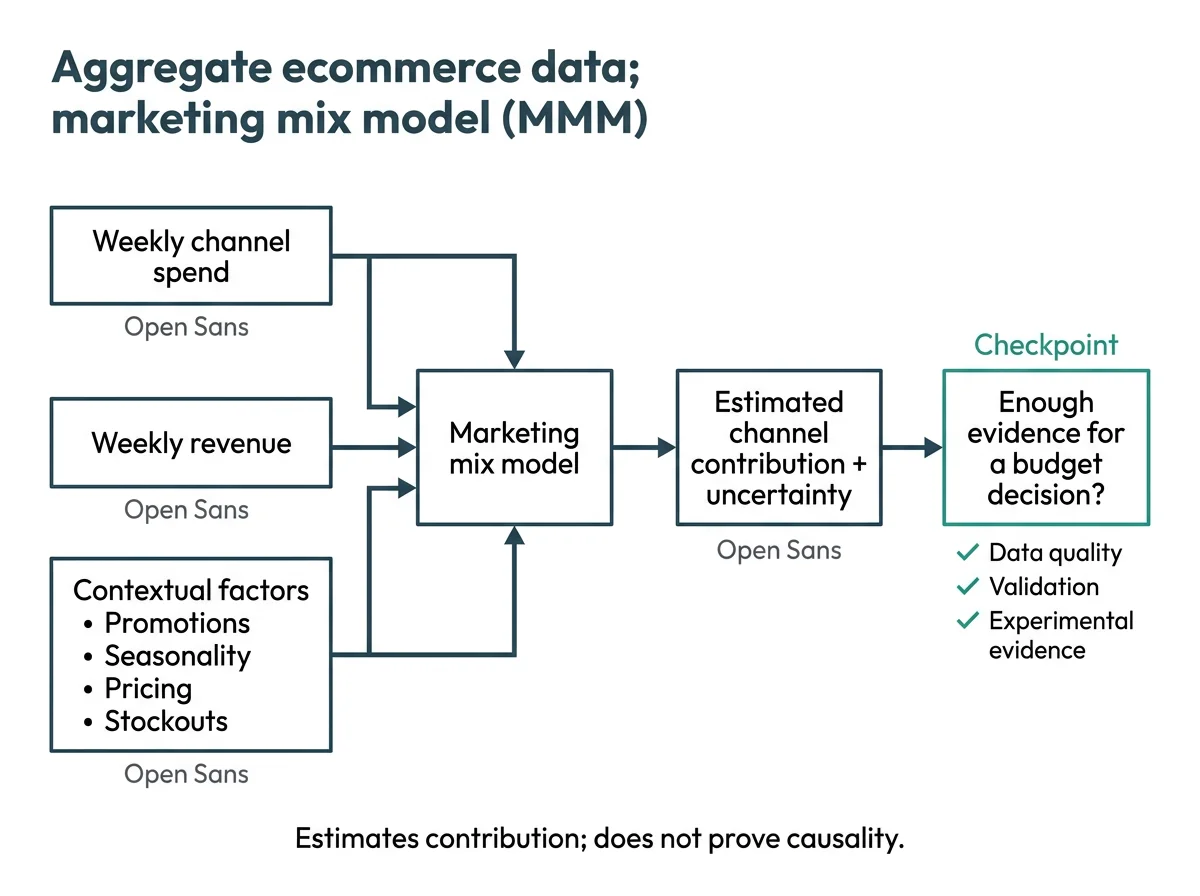
Marketing mix modeling (MMM) is a statistical approach that estimates how marketing activity and other business factors relate to sales or another outcome over time. It works with aggregate observations, such as weekly revenue and weekly channel spend, rather than reconstructing individual customer journeys.
A model might examine paid social, search, video, and other channels alongside discounts, holidays, pricing changes, and stock availability. Its purpose is to separate those overlapping relationships well enough to estimate marketing contribution and explore spending scenarios.
How MMM works in practice
- Assemble a consistent historical dataset. Align outcomes, media activity, and business context to the same time periods.
- Represent marketing effects. Account for delayed effects and diminishing returns where appropriate.
- Estimate relationships. Fit a model that explains changes in the outcome using those inputs.
- Evaluate the model. Examine predictive performance, assumptions, sensitivity, and agreement with other evidence.
- Explore scenarios. Estimate what different spending plans could produce within the model's assumptions.
Two important concepts are adstock and saturation. Adstock represents effects that persist after an ad runs. Saturation represents diminishing returns as spending increases. Both influence how the model translates past activity into future scenarios.
Contribution, incrementality, and return are different concepts
Modeled contribution is the portion of an outcome the model assigns to an input. Incrementality concerns the additional outcome caused by marketing compared with what would have happened without it. MMM can estimate a counterfactual, but the credibility of that estimate depends on the model's assumptions and its ability to separate media effects from other drivers.
A return metric also needs a clear definition. Modeled revenue divided by spend is a revenue-based return, not profit. Profit-based ROI requires margin and cost treatment. Use compatible definitions when comparing model outputs with return on ad spend or financial targets.
A model can explain historical sales patterns without correctly identifying what caused every change. A strong fit is useful, but it is not enough to justify a budget decision.
Why MMM and attribution can disagree
Platform reports, attribution, MMM, and experiments answer different questions. A platform may claim a purchase that another platform also claims. Attribution assigns credit across observed touchpoints using a particular set of rules or a statistical model. MMM examines relationships in aggregate business results.
| Approach | Main question | Key limitation |
|---|---|---|
| Platform reporting | Which conversions does this platform credit to its ads? | Credit can overlap across platforms. |
| Attribution | Which observed interactions receive conversion credit? | Credit depends on visibility and the attribution method. |
| MMM | How does aggregate performance relate to marketing and other drivers? | Contribution depends on assumptions and historical variation. |
| Incrementality testing | What additional outcome did marketing cause under the tested conditions? | Results apply to the tested audience, period, and intervention. |
Different channel rankings are not automatically errors. Search can receive credit near a purchase while upper-funnel activity contributes to demand earlier. Equally, an MMM can misallocate contribution when channels move together or important business factors are missing.
Use marketing attribution for conversion-credit context and incrementality testing for ecommerce to investigate causal lift. Neither is interchangeable with an aggregate MMM estimate.
Is MMM a practical fit for your ecommerce business?
MMM readiness is not determined by revenue alone. A large business with synchronized spending and poor records can be harder to model than a smaller business with consistent data and meaningful variation.
Conditions that make MMM more useful
- A channel-level planning question: you need to compare broad spending options, not choose between two ads.
- Consistent historical outcomes: revenue or orders are recorded with stable definitions.
- Meaningful variation: channel spending changes over time, ideally not always in lockstep.
- A mix worth disentangling: multiple channels, including activity that customer-level tracking may not capture well.
- Business context: promotions, pricing, launches, seasonality, and operational disruptions are documented.
- Analytical ownership: someone can maintain inputs, interpret uncertainty, and challenge outputs.
If search and social always increase together, the model has less information for separating their effects. If spending rises only during major discounts, it can struggle to distinguish advertising response from promotional demand.
When to start with a lighter approach
A recently launched store, frequent tracking-definition changes, sparse sales, or a very short operating history can make MMM premature. Clean reporting, attribution analysis, and a focused experiment may answer the immediate question more directly.
There is no universal minimum history or spend threshold that makes a model decision-ready. The dataset needs to capture relevant business cycles and enough independent variation for the intended level of detail. Adding more campaign columns does not create more information.
What data does a marketing mix model need?
Build one aligned time-series dataset. Weekly observations can be a practical starting point for ecommerce planning, but the appropriate granularity depends on sales volume, media timing, and the decision horizon.
- Outcome: revenue or orders for each period, with consistent treatment of refunds, taxes, shipping, currencies, and reporting dates.
- Marketing activity: spend by channel, with campaign groupings or exposure measures where useful and sufficiently supported by data.
- Commercial activity: promotions, discount depth, pricing, launches, and merchandising changes.
- Operational context: stockouts, site outages, fulfillment disruptions, and distribution changes.
- Calendar effects: holidays, seasonality, and major shopping events.
- External drivers: relevant market conditions that help explain demand beyond your own marketing.
Keep missing values distinct from genuine zero spend. Maintain consistent channel names and time boundaries. If the business changed materially—such as adding a new market or changing its product mix—the model needs to account for that shift rather than treating all periods as equivalent.
Weberlo's integrations bring together ad-platform, storefront, CRM, and revenue data for attribution and reporting. That provides complementary context when reviewing channel performance; an MMM project also needs its own aligned historical inputs and non-media business variables.
How to judge assumptions, uncertainty, and validation
A useful model should make its assumptions visible. Those include how long media effects persist, how response changes with spend, how baseline demand evolves, and which factors explain sales without paid media.
Look beyond a single return estimate
A channel with a high estimated return but a wide uncertainty range may not justify a large increase. If plausible estimates for two channels overlap substantially, a precise ranking can imply more certainty than the model supports.
Separate average return from marginal return. Average return summarizes estimated historical contribution per dollar. Marginal return concerns the additional outcome from more spending at a particular level. Saturation means a historically efficient channel may have limited room for profitable expansion.
Use multiple validation checks
- Holdout performance: evaluate predictions on periods excluded from fitting.
- Residual patterns: inspect unexplained errors, especially around promotions and seasonal changes.
- Sensitivity: examine whether reasonable changes to assumptions or inputs reverse the proposed decision.
- Experimental agreement: compare relevant modeled effects with lift-test evidence.
- Scenario realism: identify allocations that move far beyond observed spending conditions.
Predicting total revenue well does not establish that channel contributions are correct. Several channels can compensate for one another inside a model while producing similar overall predictions. Decision readiness requires more than an attractive fit score.
Marketing mix modeling example: planning the next budget
Hypothetical ecommerce example: a DTC skincare brand has a fixed monthly media budget of $100,000. It spends $55,000 on paid social, $35,000 on search, and $10,000 on video. These figures describe an invented planning scenario, not a case study or benchmark.
Search reports the strongest platform ROAS. Video receives little tracked conversion credit. Meanwhile, blended revenue efficiency is weakening, and the team wants to know whether to move $5,000 from search into video.
What the evidence says
- Attribution: search appears frequently near purchases. This explains conversion credit, not how much demand search created.
- MMM: after including promotions and seasonality, the model estimates diminishing returns for search at current spending. It suggests potential headroom in video, but video's contribution has substantial uncertainty.
- A lift test: a controlled video test estimates additional sales under its tested conditions. Its result supports investigating video expansion, without establishing the return at every future spending level.
Turn the signals into a budget hypothesis
The team does not treat the model's preferred allocation as an instruction. It compares the current plan with the proposed $5,000 shift across plausible assumptions, considers margin, and checks whether inventory can support additional demand.
If the shift remains attractive across those scenarios, the team makes a limited change with a defined evaluation window. It records promotions, monitors net revenue and acquisition costs, and sets a rollback rule tied to its financial requirements.
If reasonable assumptions reverse the decision, the better next step is gathering stronger evidence—not forcing an allocation. The practical output of MMM is a defensible hypothesis with boundaries, not certainty.
Marketing mix modeling tools and providers
Choose an implementation approach based on analytical capacity and planning needs, not the appeal of an optimization dashboard.
- Open-source frameworks: options such as Robyn, Meridian, and PyMC-Marketing provide a technical route to modeling. Teams need the skills to prepare data, configure models, interpret results, and maintain the workflow.
- Managed MMM software: evaluate how the platform handles inputs, assumptions, uncertainty, model updates, and scenario planning.
- Specialist agencies or measurement providers: evaluate analytical expertise, deliverables, transparency, and who owns the ongoing interpretation.
- Internal data-science builds: offer customization but require sustained engineering, modeling, and business support.
Evaluation criteria that matter
Prioritize clear data requirements, explicit assumptions, holdout evaluation, sensitivity analysis, and understandable uncertainty. The workflow should distinguish historical average returns from forward-looking marginal response and expose when a scenario depends on extrapolation.
Also consider data ownership, update effort, total implementation cost, and whether outputs map to the channels and budget periods your team actually controls. A model is only useful if someone can explain how its findings change the next decision.
Common MMM mistakes
- Treating estimates as exact truth: use ranges and sensitivity, not just a ranked list.
- Ignoring non-media drivers: discounts, stockouts, and seasonality can distort estimated media effects.
- Demanding unsupported detail: a dataset that supports channel planning may not support campaign-level estimates.
- Confusing fit with causal proof: prediction accuracy alone does not validate contribution.
- Comparing incompatible metrics: align revenue definitions, time periods, and return calculations.
- Making a large unmonitored shift: use measured changes with financial guardrails and follow-up evaluation.